

Marketers have embraced AI with remarkable speed.
In just a few years, AI tools have gone from „interesting experiment“ to „opened in a browser tab every morning.“ Teams are using them to brainstorm content ideas, summarize research, streamline workflows and tackle tasks that used to eat up hours of the workday.
But while AI adoption is moving at full speed, training seems to be jogging a few laps behind.
According to Brafton’s latest survey of marketers using AI, most organizations don’t have a formal AI training program in place. Instead, employees are learning through experimentation, peer recommendations and good old-fashioned trial and error.
Sometimes that means discovering a game-changing workflow. Other times it means spending 20 minutes trying to convince a chatbot that your prompt is perfectly clear.
Either way, the data suggests many organizations are building their AI capabilities while they’re already in motion. And while that approach may be helping teams move quickly, it also raises an interesting question: What happens when AI becomes too important to learn on the fly?

Most Marketers Are Learning AI Without Formal Training
We asked the 132 respondents who currently use AI in marketing whether their organization has implemented any type of AI training program.
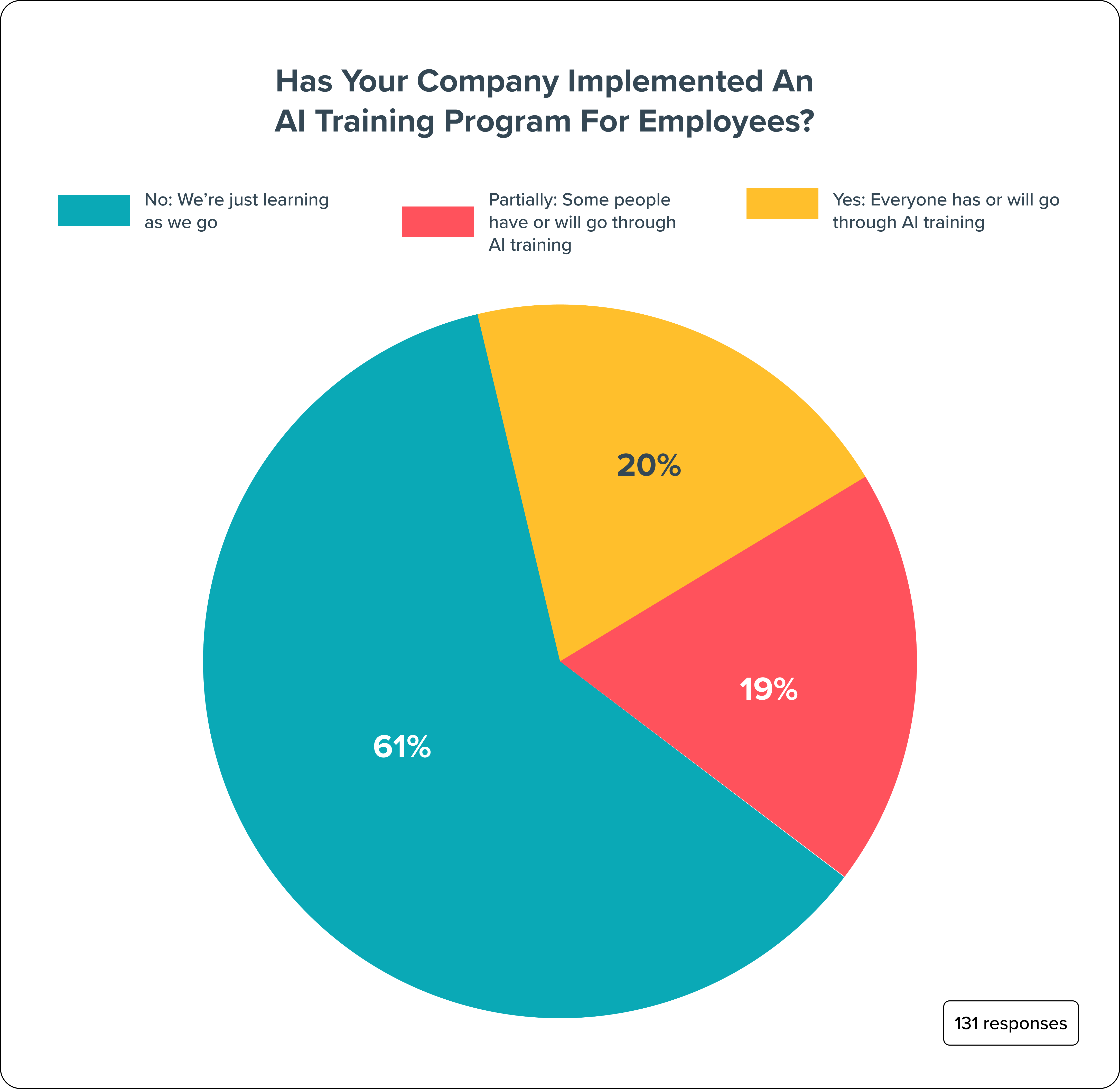
The results weren’t particularly close:
- 61% said they’re learning as they go.
- 19% said some employees have completed or will complete AI training.
- 20% said everyone has completed or will complete AI training.
In other words, nearly two-thirds of marketers using AI are essentially teaching themselves.
That may sound surprising given how quickly AI has become part of the modern marketing stack, but considering how fast the technology changes, it’s also understandable.
For many organizations, creating a formal AI curriculum probably feels like trying to hit a moving target. So instead, teams are learning by doing.
The downside is that not everyone learns the same way or has the same opportunities to experiment. Different roles, workloads and learning styles naturally lead to different levels of AI knowledge, which can create noticeable gaps across a team over time.
Subscribe to
The Content Marketer
Get weekly insights, advice and opinions about all things digital marketing.
Thank you for subscribing to The Content Marketer!
AI Adoption Is Growing Faster Than Training Programs
If there’s one thing the survey makes clear, it’s that marketers aren’t waiting for formal training before adopting AI.
Across all three groups — no training, partial training and full training — respondents reported significantly higher AI usage in 2025 than in previous years.
Among organizations learning as they go:
- 48 respondents said they used AI significantly more in 2025 than previously.
- 14 said 2025 was their first year using AI.
- 13 said they used AI somewhat more than before.
Organizations with formal training programs showed nearly identical growth patterns.
Among respondents where everyone receives training:
- 18 said they used AI significantly more in 2025.
- 6 said 2025 was their first year using AI.
Organizations offering training to some employees reported similar results.
The takeaway is straightforward: AI adoption is happening first. Training decisions are happening later.
Think about it from a marketer’s perspective.
When a tool promises to help your team create content faster, summarize research in seconds or automate repetitive tasks, it’s difficult to justify sitting on the sidelines while you wait for a formal training initiative. Most organizations are experimenting now and figuring out the structure later.
That may not be ideal from a governance standpoint, but it reflects the reality of how many emerging technologies enter the workplace. Adoption often begins at the team level long before organization-wide processes catch up.
Organizations of Every Size Are Learning AI on the Fly
The largest group among organizations without formal AI training came from companies with 1–20 employees.
That’s not surprising. Smaller teams can often move quickly, test new tools and adapt workflows without lengthy approval processes. But the bigger takeaway is that informal learning isn’t limited to small businesses.
Among the 80 respondents learning as they go, most worked at organizations with more than 20 employees, including companies with 51–500 employees and even those with more than 500 employees.
In other words, the lack of formal AI training isn’t a small-business issue. Organizations of all sizes appear to be facing the same challenge: How do you create structured training for a technology that’s constantly evolving?
For now, many companies are choosing the same approach — learn by doing.
AI Policies and AI Training Often Go Hand in Hand
One of the most revealing findings in this year’s survey involved AI governance.
Among organizations learning as they go:
- 62 reported having no AI policy.
- 18 reported having a policy.
Among organizations where everyone receives training:
- 24 reported having an AI policy.
- Only three reported having no policy.
Organizations offering training to some employees also leaned toward having formal policies in place.
This is one of those findings that probably won’t surprise anyone who’s worked in a corporate environment. Once a company creates an AI policy, someone eventually has to explain it.
That’s where training enters the picture.
Policies establish expectations around responsible use, privacy, compliance, intellectual property and quality standards. Training helps employees understand how those expectations apply to the work they’re doing every day.
The relationship between policy and training may also point to a broader trend: organizational AI maturity. Companies that have moved beyond simple experimentation are often starting to think about governance, consistency and risk management. Training becomes part of that evolution.
In other words, organizations that take AI seriously aren’t just investing in tools, but investing in the systems that help employees use those tools effectively.
What Trained Teams Seem To Gain From AI
Respondents across all three groups reported positive outcomes from AI adoption. The interesting part is how those outcomes differed, and among organizations learning as they go, the most common benefit was speed.
Respondents most frequently said AI helps them:
- Complete work faster.
- Do more things.
- Improve the quality of their work.
- Reduce costs.
That’s exactly what many marketers expect when they first adopt AI. The immediate value often comes from increased efficiency.
The results look slightly different among organizations where everyone receives training.
In that group, the top response wasn’t speed. It was: “We’re doing more things with AI.”
At first glance, the difference seems subtle, but it may reveal something important about how trained teams approach AI. Organizations without training often use AI to accelerate existing workflows. They write drafts faster, conduct research more efficiently and automate repetitive tasks.
Organizations with training may be uncovering entirely new ways to use AI. Instead of simply speeding up existing processes, they’re expanding what’s possible.
That’s an important distinction. Why? Because saving time is valuable and expanding capabilities can be transformative.
Budget Doesn’t Appear To Be the Main Factor
It’s easy to assume organizations with formal AI training simply have more money to spend, but the survey suggests the reality is more complicated.
Across all three groups, being allowed a small budget for AI tools was most common.
Among organizations learning as they go:
- 46 reported having a small AI budget.
- 33 relied on free tools.
Among organizations where everyone receives training:
- 13 reported having a small budget.
- 8 relied on free tools.
- 6 described AI as a key component of their martech stack.
The differences exist, but they’re not dramatic. In fact, many organizations with no formal training are still investing in AI tools.
This suggests the challenge isn’t necessarily access to technology. It’s deciding how much effort to invest in helping employees learn to use that technology effectively. The tools themselves are becoming increasingly accessible. The knowledge required to maximize their value may be the bigger investment.
Different Industries Are Taking Different Approaches
The survey also revealed some interesting industry trends.
Among organizations learning to use AI as they go, the largest groups came from the following industries:
- Marketing, media and creative.
- Manufacturing and industrial.
- E-commerce, retail and distribution.
- Health and wellness.
- Education.
Marketing teams may be particularly comfortable with experimentation. After all, testing, iterating and adapting are already core parts of the job. When a new tool appears, marketers tend to explore it.
Organizations providing training to all employees were more heavily represented in:
- Professional and business services.
- Technology and IT.
- Manufacturing and industrial.
These industries often place greater emphasis on standardization, documentation and process consistency.
That doesn’t mean one approach is inherently better. It simply highlights how organizational culture can influence AI adoption strategies. Some organizations are comfortable learning in public. Others prefer to establish guardrails before scaling usage. Most probably fall somewhere in between.
The Next AI Challenge May Be Skills, Not Access
For the past few years, most AI conversations have focused on access. Which tools should we use? How much should we spend? What tasks should we automate?
Those questions still matter, but the survey points to another challenge that’s becoming increasingly important: skills development. Today, AI tools are widely available. Many offer free plans. Most are becoming easier to use. Access is no longer the barrier it once was.
The bigger differentiator may be knowledge.
Two marketers can sit down with the same AI platform and produce dramatically different results. One creates efficient workflows, generates useful outputs and understands how to evaluate quality. The other spends half the afternoon rewriting mediocre content and wondering what all the hype is about.
The difference isn’t the tool. It’s the user.
As AI adoption becomes more widespread, organizations may find that competitive advantage comes less from having access to AI and more from helping employees develop expertise.
What These Findings Mean for Marketing Leaders
Marketers aren’t waiting around for an AI training manual. They’re experimenting, sharing tips with colleagues and figuring things out as they go. So far, it’s working well enough to drive widespread adoption and measurable results.
But eventually, simply using AI won’t be noteworthy. It’ll be expected. When that happens, the competitive advantage won’t come from having access to the technology. It’ll come from knowing how to use it better than everyone else.
And that’s where training, knowledge-sharing and AI expertise may start to matter a lot more.