Generative engine optimization (GEO) is the practice of optimizing content, brand entities and digital presence so your business gets cited, summarized and recommended inside generative AI engines like ChatGPT, Google AI Overviews, Perplexity, Gemini and Copilot.
Traditional search engine optimization (SEO) helps your pages rank in search engine results pages (SERPs). GEO helps your brand become part of the answer when AI systems respond to user questions.
Summary
- What it is: GEO optimizes content to earn citations in generative AI engines, extending visibility beyond traditional search rankings.
- How it’s different from SEO: SEO targets clicks from a results page. GEO targets mentions inside an AI-generated answer.
- Why it matters: Google AI Overviews now appear on a majority of informational and even commercial queries, and AI search tools are changing how users discover brands before a click happens.
- How to do it: Publish source-rich, well-structured content, strengthen your brand entity, earn mentions across high-authority sources and optimize for conversational long-tail queries.
- How to measure it: Track AI visibility score, citation count, brand mentions and referral traffic from AI platforms.
Table of Contents
What Is Generative Engine Optimization?
Generative engine optimization is a digital marketing strategy for improving brand visibility inside AI-powered search and answer tools. It applies to ChatGPT, Google AI Overviews, Perplexity, Gemini, Microsoft Copilot and other LLM-driven discovery experiences.
Whereas a traditional search engine functions like a directory by returning links, a generative engine assembles an answer. That answer may cite sources, name brands, compare vendors, recommend tools or summarize several pages without sending the user to a website right away. Optimization needs to account for that.
Your content still has to be useful for people, but it also has to be easy for AI systems to parse and attribute. GEO is the discipline of making your presence clearer across your website and the wider web.
Where the Term Came From
The term „generative engine optimization“ gained traction after researchers published GEO: Generative Engine Optimization, a paper studying how content could be optimized for engines that synthesize and cite information instead of ranking links alone. The researchers found that GEO methods could improve visibility in generative engine responses by up to 40%.
Why GEO Emerged Now
Search is no longer confined to the results pages. People still use Google at an enormous scale, but they’re also encountering AI Overviews above organic listings, asking ChatGPT to compare options and using Perplexity, Gemini or Copilot to summarize complex decisions.
AI Overviews appear for 73% of U.S. queries, Advanced Web Ranking datashows. In a separate Pew Research Center analysis of March 2025 browsing data, users who encountered an AI summary clicked a traditional result in 8% of visits, compared with 15% of visits without an AI summary.
SparkToro’s 2024 estimate placed Google search volume at roughly 373 times ChatGPT’s. SEO remains the foundation; GEO extends search strategy into answer-driven discovery.

GEO vs. SEO: Are They the Same Thing?
GEO and SEO are closely connected, but they are not the same.
Think of GEO as the next layer of search strategy. SEO helps your content rank in traditional search results. GEO helps your content appear inside AI-generated answers.
GEO vs. SEO At a Glance
| Dimension | Traditional SEO | Generative Engine Optimization |
| Primary goal | Rank a page in organic results. | Get your brand cited, summarized or recommended inside an AI-generated answer. |
| Target surface | Google, Bing and other search engine results pages. | ChatGPT, Google AI Overviews, Perplexity, Gemini, Microsoft Copilot and other generative engines. |
| What success looks like | A blue link in positions 1-10 that drives clicks. | A citation, link or unlinked brand mention inside an AI-generated response. |
| Primary unit of value | A click to your website. | An impression, citation or recommendation inside an AI answer, with downstream click potential. |
| User query style | Short, keyword-based searches. | Conversational, specific, multi-part questions. |
| Content format that wins | Long-form articles, landing pages and comparison posts. | Modular, source-rich, well-structured content with clear headings, bullet points, tables and citations. |
| Keyword strategy | Head terms and long-tail variations with defined search volume. | Topic clusters, questions and conversational phrases, including query fanout. |
| Backlinks role | Core ranking signal. | Still valuable, but unlinked brand mentions, third-party citations, YouTube, G2 and news sources can also matter. |
| Schema and structured data | Helpful for rich results. | Increasingly important for machine-readable context. |
| Core success metric | Organic traffic, keyword rankings and click-through rate. | AI visibility share, citation count, brand mention frequency, AI-referral traffic and commercial outcomes. |
| Internal owner | SEO lead and content marketing team. | SEO, content, brand, PR and digital strategy teams. |

What SEO Optimizes For
SEO optimizes websites and content to rank in search engine results pages.
That includes:
- Crawlability.
- Indexability.
- Keyword relevance.
- Content quality.
- Page structure.
- User experience.
- Internal linking.
- Backlinks.
- Schema markup.
- Authority.
- Technical performance.
Strong SEO helps search engines find, interpret and rank your content. It also helps users find the information they need at the right point in their journey.
At its best, SEO uses data, technology, content and outreach to become the final stop on a qualified user’s search journey.
What GEO Optimizes For
GEO optimizes content and brand presence, so generative engines can find, understand, cite, summarize and recommend it.
That includes:
- Clear answers.
- Topic authority.
- Source credibility.
- Structured formatting.
- Entity recognition.
- External validation.
- Brand consistency across the web.
- Fresh, useful content.
- AI-visible citations and mentions.
If SEO asks, “Can this page rank?” GEO also asks, “Can this answer be extracted, trusted and used?”
The Overlap
Much of GEO work still relies on strong SEO fundamentals. Both reward relevance. Both depend on audience intent. Both perform better when content is clear, well-structured, credible and useful.
The difference is the environment.
In traditional search, users choose from a list of results. In generative search, the system may choose which sources to synthesize into a single answer.
That’s why GEO is continuity, not disruption. You still need to understand the audience, cover the topic clearly, organize information well and give people a reason to trust what they are reading.
Myth: SEO Is Dead
People have been predicting the death of SEO for years. Spoiler: It keeps not dying.
AI-driven search referrals still account for a small portion of overall traffic compared with traditional search. Organic search still drives meaningful traffic, conversions and commercial outcomes. Rankings still influence visibility. Search engines still need crawlable, useful, authoritative content.
The better argument is that SEO is evolving.
Traditional rankings are now part of a broader visibility ecosystem that includes AI Overviews, chat answers, video, third-party sources, rich snippets and brand mentions.
So no, SEO is not dead — but the old playbook’s not enough by itself.

How Generative Engine Optimization Works
Generative engines gather information, evaluate sources, synthesize answers and, in some environments, cite supporting material.
How LLMs Select and Cite Sources
Large language models (LLMs) may work through a process like this:
- Retrieval: The system gathers potentially relevant sources or context.
- Evaluation: It weighs relevance, authority, recency, clarity and source quality.
- Synthesis: It turns information from multiple sources into a generated answer.
- Attribution: In some environments, it cites, links to or names sources that support the answer.
ChatGPT, Perplexity, Gemini and Google AI Overviews do not behave the same way, so single-platform tricks age quickly. Focus on signals that travel well, like topic depth, clarity, credibility, structure, freshness and brand consistency.
What Generative Engines Look For
Generative engines need information they can interpret quickly, which means they’re looking for clear writing and clean formatting.
The content most likely to support AI visibility is usually:
- Structured for machine readability: Headings, subheadings, bullets, tables and schema clarify what each section covers.
- Written for AI and humans: The copy answers questions directly without losing usefulness or brand voice.
- Comprehensive enough to support the topic: The page connects the primary question with related subtopics and follow-up questions.
- Grounded in E-E-A-T: Experience, expertise, authority and trust still matter, especially when AI systems compare sources.
Strong structure lets readers scan and helps AI systems identify which facts belong together.
Query Fanout: The Hidden Queries Behind Every AI Answer
Query fanout refers to the related searches an AI system may run while building an answer around a user’s original question.
If someone asks, „What is generative engine optimization?“ an AI system may also need answers to questions such as:
- How is GEO different from SEO?
- What is answer engine optimization?
- How do AI Overviews cite sources?
- What tools track AI visibility?
- What content formats get cited by LLMs?
- How do brand mentions affect AI answers?
But optimizing for the parent query alone leaves gaps. The surrounding questions matter too.
Topic clusters help teams connect a primary query with the supporting questions people ask next. That produces more complete coverage than treating each keyword as an isolated page.
Content Chunking: Make Information Easier To Navigate
Content chunking breaks information into clear, self-contained sections that readers and AI systems can understand, quote and reuse.
Use this checklist when creating content chunks:
- Lead each major section with a direct answer.
- Use descriptive H2s and H3s.
- Keep paragraphs short.
- Use bullets for grouped ideas.
- Use numbered lists for processes.
- Include tables for comparisons.
- Add verifiable facts, data points and source links.
- Avoid burying the answer below a long setup.
- Make every section useful on its own.
Schema as a Translator Layer
Schema markup gives search engines and AI systems explicit context. It can clarify whether a page is an article, FAQ, product page, review, how-to guide, local business page or video. However, a schema will not rescue weak content.
The GEO Content Lifecycle
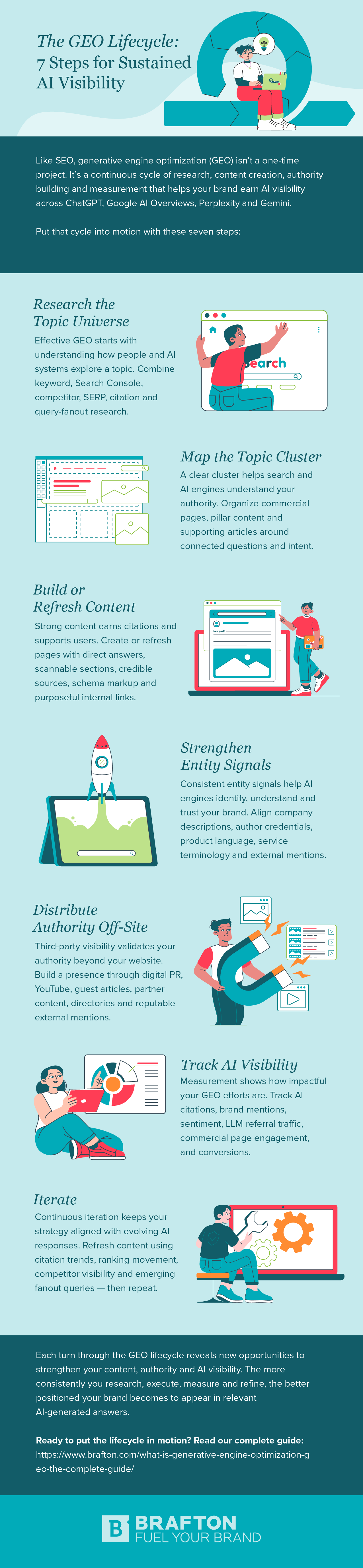
GEO is not a one-time page edit. Like SEO, it has a lifecycle.
1. Research the topic universe: Use traditional keyword research, Search Console, competitor analysis, SERP analysis, AI Overview analysis and query fanout.
2. Map the topic cluster: Identify commercial landing pages, pillar content and supporting blogs.
3. Build or refresh content: Create net-new content or optimize existing pages with chunked structure, direct answers, sources, schema and internal links.
4. Strengthen entity signals: Align brand descriptions, author expertise, product language, service language and external mentions.
5. Distribute authority off-site: Use YouTube, digital PR, guest articles, partner content, directory profiles and reputable third-party mentions.
6. Track AI visibility: Monitor citations, mentions, sentiment, referral traffic, commercial clicks and conversions.
7. Iterate: Refresh content based on AI answer changes, SERP movement, competitor citations and new fanout queries.
Why GEO Matters for Your Brand in 2026
GEO matters because users are changing how they search. They still use Google, click organic results and visit websites, but they also ask AI systems to summarize, compare, explain and recommend. AI systems can evaluate your brand before users reach your site.
What You Lose If You’re Invisible to AI
If your brand does not appear in AI-generated answers, you may lose early research visibility, authority in category conversations, brand recall, control over how your offering is framed and trust signals that support later conversion.
What You Gain by Being Cited
Citations and brand mentions can put your business in view during a buyer’s research process. A GEO program can help you develop the content, authority and measurement needed to compete for visibility in those moments the buyer is still deciding what to believe.
The AI Search Shift in Numbers
AI search is changing the math of visibility. Here are the numbers worth watching:
- 60.3273% of U.S. queries in a 2025 snapshot showed AI Overviews, according to Xponent21’s analysis of Advanced Web Ranking data.
- Traditional results drew clicks on 8% of visits when an AI summary appeared, compared with 15% of visits without one, according to Pew Research Center’s March 2025 browsing-data analysis.
- Google’s search volume is roughly 373 times larger than ChatGPT’s, based on SparkToro’s 2024 estimate.
- Sites ranking for multiple queries in a single topic cluster are 161% more likely to be cited in an AIO, according to ALM Corp.
- Pages featured in AI Overviews had nearly six times the organic traffic of pages not featured in Brafton’s observational research.
- AI Overview-featured pages had 31% more backlinks and roughly 30% more referring domains on average in the same Brafton research.

The Zero-Click Paradox
AI-generated answers can reduce clicks on informational keywords by satisfying users immediately. That’s the uncomfortable part.
Pew’s analysis measured lower click rates when an AI summary appeared. However, it did not measure lead quality, so teams should not assume fewer clicks are automatically more qualified clicks.
The zero-click problem looks like this:

Total clicks may decline.

Visibility may increase.

The mix of traffic may change.

Conversion patterns may not match session trends.

Reporting can look worse if it measures sessions alone.
Before drawing a conclusion about performance, it’s best to compare visibility, engagement and conversion.
How To Do GEO: The Brafton Framework
A practical GEO strategy combines SEO fundamentals with AI-specific optimization. Keep the foundation (crawlable pages, useful content, internal links and authority). Then add topic clusters, query fanout, content chunking, off-site signals, video strategy and measurement models that capture AI visibility.
The following steps can help turn a solid SEO foundation into a strategy built for generative search.
1. Run a Focused Audit
Start by identifying where AI search is already affecting visibility. Review crawlability, indexability, internal linking, page clarity, accessibility, AI Overview presence, LLM citations, brand sentiment and competitors earning citations on priority topics.
Then, answer 3 questions:
- Where are we already visible?
- Where are competitors being cited instead?
- Which actions are most likely to improve business-relevant visibility?
2. Upgrade Your Highest-Value Content
Prioritize striking-distance opportunities. These are terms where you already rank on Page 1 but are absent from AI Overviews or LLM citations.
Upgrade those pages with direct-answer summaries, clearer H2 and H3 structure, missing subtopics, expert commentary, bullets, tables, source links, internal links, schema markup and closer alignment with natural-language questions.
Early wins often come from pages that already matter to the business but need stronger sourcing, clearer structure or better topical coverage.
3. Create Net-New Content for LLMs
Some gaps will need new content. Begin by analyzing prompt opportunities for high-intent LLM questions where competitors are currently cited. Then create guides that answer those prompts fully.
Net-new GEO content should answer the prompt early, use conversational headings, include source-rich explanations, add proprietary data where possible, cover the topic cluster and still earn the click.
4. Build External Authority and Outreach
GEO does not stop at your website. Generative engines also draw signals from third-party sources, video platforms, review sites, directories, industry publications and partner pages.
Build off-site authority through guest articles, digital PR, high-authority placements, review sites, industry directories, partner pages, social profiles, unlinked brand mentions, YouTube videos, transcripts and relevant product listings.
External validation is important because AI systems may use sources you do not control.
5. Measure, Discuss and Refine
Like SEO, GEO isn’t a set-it-and-forget-it kind of strategy. AI answers change, competitors publish, platforms update citation behavior, and search behavior itself shifts.
It’s important to track metrics around Google AI Overview citations, LLM mentions, sentiment, competitor visibility, AI referral traffic, organic impressions, engaged sessions, commercial landing page clicks, conversions, topic cluster performance and revenue per page.
Use those findings to guide the next round of work. Review where competitors appear, whether AI-generated descriptions of your brand are accurate and whether commercial pages are attracting qualified visitors and conversions. Then adjust your content priorities, authority-building efforts and conversion paths accordingly.
YouTube as a GEO Channel
YouTube can extend a topic cluster through public video, searchable transcripts, descriptions, chapters (timestamps) and links back to relevant site content.
How YouTube Can Support GEO
YouTube supports GEO by creating structured, searchable transcripts around key topics. A strong strategy can answer fanout questions in video format, reinforce brand entities and drive users back to relevant pillar pages, landing pages and blog content.
Video is especially useful when the topic benefits from explanation, demonstration, comparison or expert commentary.
The 3 YouTube GEO Tactics
- Transcript optimization: Include high-intent topics, natural-language answers and brand signals in spoken content.
- Semantic timestamping: Use YouTube Chapters to answer specific subquestions.
- Multimodal signals: Align visuals, spoken copy, descriptions and metadata around the topic cluster.
Long-Form vs. Shorts
Long-form video supports depth, expertise and topical authority. Shorts can capture long-tail intent and answer quick conversational queries with higher engagement. Use both, and connect each format back to relevant pillar pages, landing pages and supporting blog content.
How To Brief a GEO-Ready Video
Choose a query or supporting question, answer the central point early, use descriptive chapter markers, keep the transcript clear and link to the relevant pillar or landing page.

GEO Tools, Software and Services
GEO tools are still evolving. Some track AI citations, some monitor brand mentions and some analyze AI Overviews or prompt-level visibility. Triangulate across sources.
Visibility Tracking Tools
Examples include:
- Ahrefs.
- Semrush.
- Google Search Console.
- Or manual prompt tracking.
Use these tools to monitor AI Overview citations, LLM citations, AI share of voice, brand mentions, competitor mentions, prompt-level visibility, sentiment and referral traffic patterns.
Content Optimization and Brand Monitoring Tools
Content optimization tools can help teams decide what to create, update and connect. Look for workflows that support keyword research, query fanout, topic clusters, content scoring, SERP analysis, internal linking, schema recommendations and refresh prioritization.
GEO also depends on how AI systems understand your brand. Monitor AI-generated answers, review platforms, directories, social profiles, partner pages, news mentions, forums, third-party comparison pages and product listings where relevant.
Brand Sentiment Analysis
One of the most useful GEO questions is, “What are AI tools saying about us when we are not in the room?”
Brand sentiment analysis looks at whether AI-generated answers mention you positively, neutrally or negatively; whether competitors appear more often; and whether your services are described accurately. At this point, GEO becomes brand intelligence.
When To Hire a GEO Agency
You may need a GEO agency if:
- You rank organically but do not appear in AI answers.
- Competitors are cited more often.
- AI answers describe your brand inaccurately.
- Your team lacks visibility into LLM mentions.
- Content is scattered across unconnected blog posts.
- SEO, content, PR and brand teams are siloed.
- Reporting still depends only on rankings and sessions.
- Your team knows GEO matters but doesn’t know where to start.
A strong GEO partner should bring together priority keyword research, AI content optimization, sentiment analysis, authority signals, AI trend monitoring, third-party partnerships, schema markup and entity optimization.
How To Measure GEO Success
GEO measurement should show where your brand appears in AI-generated search, how that visibility influences engagement across a topic cluster and whether it contributes to commercial results.
Search reporting has traditionally centered on rankings, clicks, impressions and conversions. Those metrics still matter. But AI Overviews and large language models can introduce a brand, explain its value and shape a buyer’s next move before anyone visits the site. A useful GEO scorecard should therefore connect AI visibility with traffic quality and business performance.
Why Measurement Has To Evolve
The rollout of AI Overviews, AI Mode and LLM-powered search has changed how people move through the search journey. In some cases, an AI-generated answer resolves an early-stage question without producing a click. In others, it may send a more informed visitor to a supporting article or commercial landing page.
That creates a broader set of questions for search teams:
- Are AI systems citing our brand for priority topics?
- Which competitors appear in those answers instead?
- Is the brand being described accurately?
- Are we visible across the full topic cluster, rather than for one or two isolated pages?
- Are AI referrals producing engaged visits?
- Are commercial pages gaining traffic or conversions as supporting content becomes more visible?
- Are conversions holding steady or increasing even when informational traffic declines?
Raw traffic alone cannot answer those questions. That’s why it’s important to measure brand visibility, engagement quality and commercial impact together.
The 9-Metric New-Era KPI Framework
| Metric | Why It Matters | Source |
| Organic clicks to commercial landing pages | Shows whether broader topic visibility is helping revenue-driving pages attract qualified visitors. | Google Search Console |
| Organic clicks to topic-relevant pages | Keeps reporting tied to pages and topics that support the business, rather than traffic that has little commercial value. | Google Search Console |
| Search impressions | Captures search visibility and reach, including situations where fewer users click through from the results page. Review by topic where possible. | Google Search Console |
| Engaged sessions | Indicates whether visitors continue interacting with the site after arriving from search or AI platforms. | GA4 |
| Conversions | Connects search activity to the commercial actions that matter, such as form submissions, demo requests, calls or purchases. | GA4 |
| Revenue per page | Shows whether pages are generating more business value, even when overall traffic is flat or declining. | GA4, CRM and revenue attribution tools |
| Referral traffic from LLMs | Tracks visits from AI platforms where referral data is available and provides a view of their engagement and conversion behavior. | GA4 |
| AI Overview citations | Measures whether the brand appears in Google’s AI-generated results for priority queries and how that visibility compares with competitors. | Semrush, Ahrefs or AI visibility tools |
| LLM citations | Tracks brand mentions and citations across platforms such as ChatGPT, Gemini and Perplexity. Treat results as directional snapshots because outputs can vary by prompt, location, time and reasoning mode. | AI visibility tools and manual checks |
| AI share of voice | Shows how often the brand appears in AI-generated answers compared with relevant competitors. | AI visibility tools |
The SERP Is the New Funnel
The search journey no longer follows a neat path from query to blue link to conversion. An AI-generated answer may introduce a brand, compare vendors, summarize benefits and point users toward the next step before they visit a website.
Measure GEO performance across the full funnel:
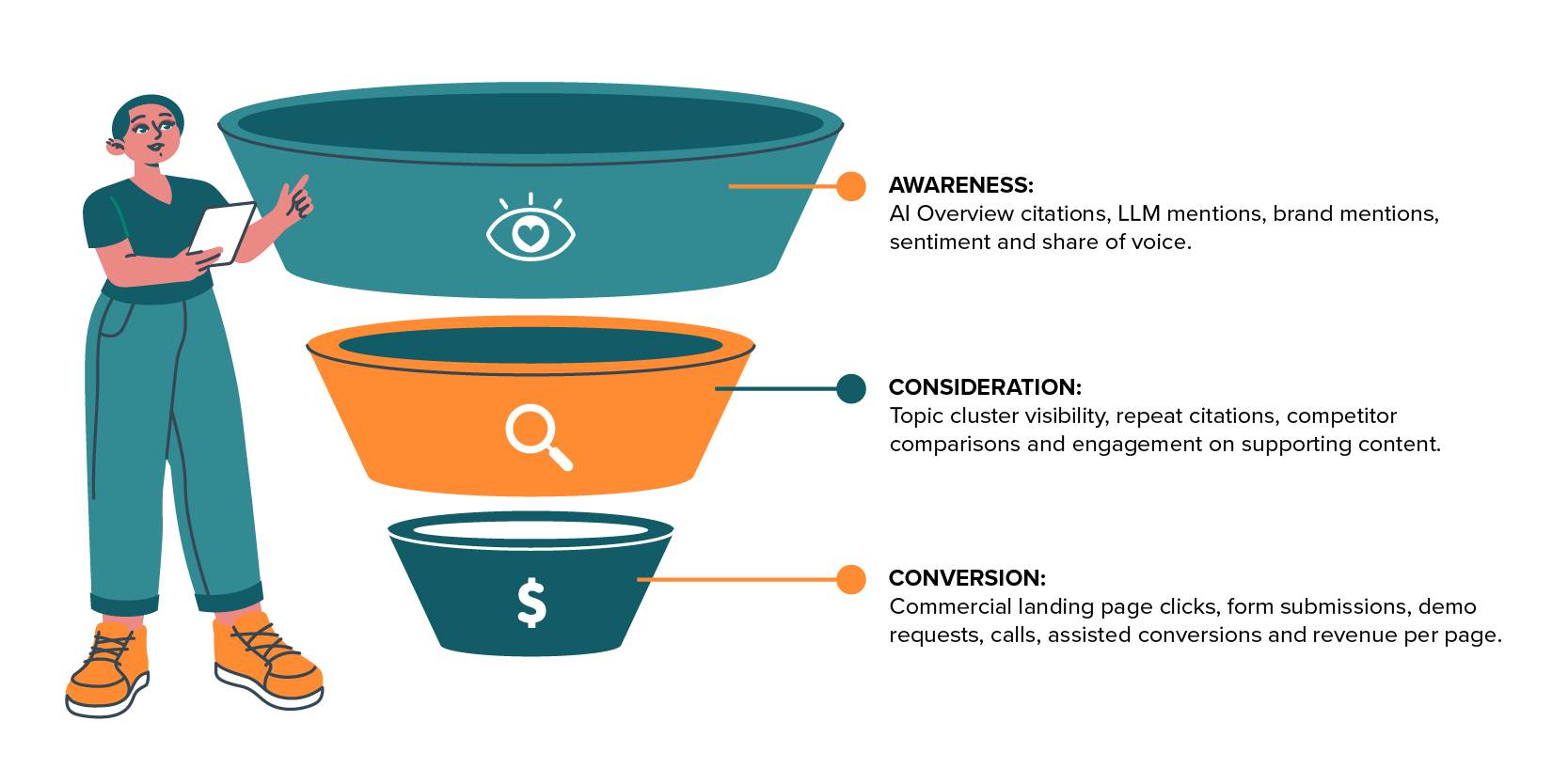
- Awareness: AI Overview citations, LLM mentions, brand mentions, sentiment and share of voice.
- Consideration: Topic cluster visibility, repeat citations, competitor comparisons and engagement on supporting content.
- Conversion: Commercial landing page clicks, form submissions, demo requests, calls, assisted conversions and revenue per page.
How To Set Up Tracking
Start with a practical system that combines platform data, AI visibility monitoring and regular human review.
- Track AI referral traffic in GA4 and use UTM parameters when available.
- Monitor AI Overview citations at the query level, especially for priority keywords and commercial topics.
- Run recurring prompt checks across relevant LLMs to review citations, competitor mentions and brand descriptions.
- Group your findings by topic cluster so you can identify whether visibility is building across a meaningful area of expertise.
- Connect those observations to engagement and conversion data.
The goal isn’t to prove that a single citation directly caused a sale. It’s to understand whether stronger AI visibility aligns with better performance across the search funnel.
Measurement Blind Spots To Avoid
A GEO report can become misleading when it relies on only one type of signal. Avoid these common mistakes:
- Treating organic sessions as the only measure of success.
- Ignoring AI citations, brand mentions and sentiment.
- Measuring one URL at a time instead of evaluating topic clusters.
- Assuming one ChatGPT, Gemini or Perplexity response represents every user’s experience.
- Reporting citations without reviewing which competitors appear alongside the brand.
- Failing to connect AI visibility with commercial landing page traffic, conversions and revenue.
GEO measurement will continue to evolve as search platforms and reporting tools change. For now, the strongest approach is to combine visibility data with engagement and commercial outcomes, then use that information to refine the next round of content, optimization and authority-building work.
GEO Case Studies: Real Results From Brafton Clients
GEO becomes easier to evaluate when you can see how it affects real search performance. These Brafton client examples show how stronger topic coverage, AI-ready content structures and ongoing optimization can improve visibility across traditional search and AI-generated results.
Financial Advisory Company: Reclaiming SERP Feature Visibility
A financial advisory company had strong organic rankings but was losing traffic and click-through rate as search results increasingly offered AI-generated features.
Brafton developed a GEO-focused strategy that combined keyword research, localized topic ideation, AI Overview-ready content structures, LLM narrative alignment and content re-optimization.
Results included:
- +2,477% YoY SERP feature ownership.
- +373 AI Overview citations regained.
- +252% YoY Page 1 keyword rankings.
- +67% YoY organic sessions.
- +295% YoY organic form submissions.
- +17% QoQ time on site.
TruGreen: Expanding Residential Search Visibility
TruGreen wanted to increase residential organic visibility in a highly competitive lawn care market.
Brafton supported the program with SEO analysis, content pruning, ongoing keyword research, content briefs and blogs designed to serve human readers while remaining easy for generative engines to interpret and cite.
Results included:
- +64% YoY organic ranking keywords.
- +67% YoY Page 1 rankings.
- +228% YoY blog impressions.
- +40% YoY blog clicks.
- +192% YoY website impressions.
- 73% of Brafton-created blogs ranking on Page 1.
- Nearly half of Brafton-created blogs earned Position 1 rankings or AI Overview visibility.
International Educational Services Company: Building AI Overview Presence
An international educational services company already had a solid SEO foundation but limited visibility in AI Overviews.
Brafton identified high-priority keywords that triggered AI Overviews, analyzed the types of sources Google cited and provided targeted content optimization recommendations.
Results included:
- 50% of analyzed URLs securing AI Overview presence.
- +103 new ranking keywords.
- +44% increase in impressions.
- +108% increase in keyword rankings across optimized URLs within three weeks.
Signs You Need GEO and Common GEO Mistakes
GEO becomes a priority when your website still appears in search but is losing its place in the answers that shape discovery, comparison and purchase decisions. For a fuller diagnostic, see our guide: 6 Signs Your Website Needs a Generative Engine Optimization Strategy.
Signs Your Current Search Strategy Needs to Evolve
A few patterns are worth investigating:
- You are getting seen but not chosen: Impressions rise while clicks decline, suggesting users may be resolving questions in AI Overviews or other zero-click search experiences before reaching your site.
- Your content exists, but it’s not appearing in AI-generated answers: Pages that are vague, outdated, poorly structured or disconnected from related content can be harder for AI systems to interpret and cite.
- AI tools keep mentioning competitors instead of your brand: Review which companies appear, what sources support their claims and whether they have stronger topical coverage, off-site authority or clearer answers.
- AI Overviews dominate priority results, but your brand is absent: Strong traditional rankings may not be enough when Google presents a generated answer above the organic listings.
- Branded searches return third parties before your owned channels: Inconsistent service pages, outdated profiles, weak review management or unclear brand positioning can leave AI systems relying on other sources to define your business.
Common GEO Mistakes To Avoid
- Treating GEO as a separate experiment: SEO, content, social, PR, video and brand teams should work from shared audience needs, business goals and messaging. Scattered tests create duplicated effort and inconsistent signals across the web.
- Measuring only rankings and sessions: Organic traffic still matters, but it cannot explain whether your brand is being cited, described accurately or considered alongside competitors. Track patterns across visibility, engagement, branded search and commercial outcomes.
- Publishing thin, generic content in the name of being AI-friendly: Clear structure helps, but content needs something worth extracting. Specific expertise, original perspective, useful examples and practical depth help distinguish your brand from pages that could have been written by anyone.
GEO isn’t a shortcut around solid marketing work. It’s a way to coordinate that work around the search experiences your audience increasingly uses to find answers.
Related Concepts: AEO, LLMO, AIO and Semantic SEO
GEO is not the only term used to describe optimization for AI-driven search. Here’s how the related concepts fit together:
- Answer engine optimization (AEO): Structures content to answer user questions directly in Featured Snippets, answer boxes, voice search, FAQs and AI-generated summaries. AEO overlaps with GEO but has a narrower focus on direct-answer formats.
- Large language model optimization (LLMO): Focuses on helping LLMs understand, summarize, cite and recommend a brand or piece of content. GEO is the broader umbrella because it also includes AI Overviews, answer engines and conversational search tools.
- AI optimization (AIO): AIO doesn’t always refer to Google’s AI Overviews. It can also refer to optimizing for AI-powered search, using AI to improve marketing workflows or applying automation to digital experiences. The term is broad, so GEO is usually more precise when discussing visibility in generative AI answers.
- Semantic SEO: Focuses on meaning, entities, relationships and topical depth rather than exact-match keywords alone. It helps search engines and AI systems understand a page’s subject matter and how related concepts connect.
Which Term Should Your Team Actually Use?
- Use GEO when talking about visibility inside generative AI answers.
- Use SEO when talking about traditional organic search.
- Use AEO, LLMO and semantic SEO as supporting concepts.
The Future of GEO
GEO will keep changing as search becomes more conversational, visual and personalized, but the fundamentals will remain familiar. What changes is how often AI systems assemble those signals into an answer before a user reaches a website.
Where the Technology Is Heading
Agentic search could make AI systems more active researchers, pulling together information from multiple sources before responding. Multimodal queries will increasingly blend text, images, video and voice. Personalization may also make results less uniform, with answers shaped by a user’s location, search history, device or stated needs.
What Changes for Marketers in the Next 12-24 Months
Marketers will need to think beyond individual rankings and pages. Topic coverage, source quality, brand consistency and format diversity will matter more as AI systems look for information they can compare, summarize and cite. The work will also become more iterative, as teams monitor priority prompts, review competitor visibility and refresh content as platforms and user behavior shift.
The Skills GEO Practitioners Need
Strong GEO practitioners need a mix of SEO, content strategy, technical fluency and brand judgment. They should know how to research audience questions, structure content for clarity, evaluate AI-generated answers, identify citation gaps and connect visibility data to commercial goals.
GEO FAQs
Audit current visibility, prioritize high-value topics, improve existing pages, fill content gaps, strengthen authority signals and track results.
Timing varies by topic, competition, site authority and the scope of needed improvements. Expect ongoing optimization rather than a one-time result.
AEO focuses on direct-answer formats. GEO is broader, covering AI Overviews, LLMs and other generative search experiences.
It measures how often a brand appears in answers from tools such as ChatGPT, Gemini and Perplexity.
LLM SEO is an informal term for improving visibility in large language model-powered search and answer tools.
AI can support research, outlining, analysis and workflow efficiency, but strategy, fact-checking and quality control still need human oversight.
It can be useful when reviewed and improved by people. Publishing generic, unverified copy is unlikely to support lasting visibility.

Make Your Brand Part of the Answer
GEO does not replace SEO. It builds on the work that already earns trust in search: useful content, clear site structure, credible expertise and a consistent brand presence across the web.
As search evolves, the brands that remain visible will be the ones that make it easier for people and AI systems alike to understand what they do and why they matter.