

Many businesses thrive on doing things for you that you could do yourself. For example, you could go through all your expenses and receipts and file your own taxes — or you could pay someone to do it for you while you watch professional wrestling.
You could paint your living room yourself or you could pay a professional and not spend years being haunted by the paint you accidentally got on the baseboard.
You could pay a barber to cut your hair or you could try to do it yourself before, in a fit of frustration, just shaving your head and telling people that, actually, no, you definitely meant to go for the bald look.
When it comes to search engine optimization (SEO), does organic search vs paid search have the same dynamic? Not exactly.
Let’s define both strategies, discuss how they differ and how each can help grow your business.
Organic Search vs Paid Search: Definitions
As their names suggest, both are types of search results. Each strategy seeks to drive clicks and conversions, but their approaches are different.
Let’s define each term before delving into the comparison:
Subscribe to
The Content Marketer
Get weekly insights, advice and opinions about all things digital marketing.
Thanks for subscribing! Keep an eye out for a Welcome email from us shortly. If you don’t see it come through, check your spam folder and mark the email as „not spam.“
Organic Search
An organic search result is one that a search engine features because it thinks it’s highly relevant to the search input. Organic traffic comprises visitors to a website who come from organic — i.e., unpaid — search results.
No doubt, you have been one of these organic search visitors to a website. You’ve probably searched for something like “green curry recipe” and then seen a search engine results page (SERP) full of links to delicious cooking instructions.
Maybe you clicked on three separate results because the first link involved ingredients you don’t have, the second was too confusing and the third began with 17 paragraphs of the author’s trip to Thailand 8 years ago. Then you searched, “Thai restaurant near me” and just ordered delivery.
Each link you clicked on in your green curry journey made you an organic visitor to that site. Unless you clicked on a sponsored link atop the SERP, that is.
Paid Search
Paid search advertising — often called “pay per click” or PPC — involves paying the search engine to display an ad at the top of a SERP. The benefit of appearing first, second or even third on a SERP is clear — people will see your ad before seeing other links. But just how advantageous is this?
About 60% of all clicks occur on the top 3 positions in SERPs. 60%.
Paid search is available on all the major search engines, such as Bing, DuckDuckGo and Ecosia. But Google is by far the most popular search engine, so if you’re interested in paid search, it definitely makes sense to experiment with Google Ads.
Organic vs Paid Search: Key Differences
What are the differences between organic search results and paid search results? They both go to the same place — your website — right? So, is it just as simple as paying for one while the other happens naturally?
Not quite. Here are some key differences:
The Cost of Organic vs Paid Search
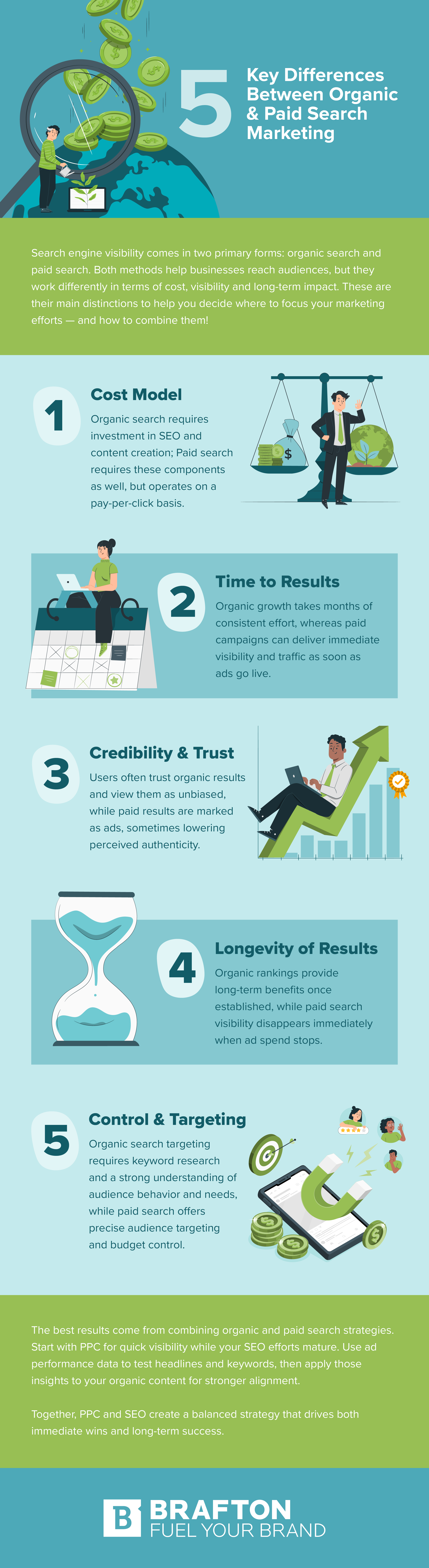
The most obvious is you have to pay for one and not the other. An effective organic result requires content that uses 1 or more relevant keywords enough times that a search engine recognizes it pertains to a particular topic. Paid search requires, well, payment. But it’s not fair to say organic results come completely free.
The Challenges of Organic Search
Organic search ranking isn’t always easy. It rarely is. The efficacy of organic SEO depends on so much: what keywords you’re trying to rank for, where you are, which audience you’re targeting, how much competition you have and more.
An effective organic listing often requires keyword research, highly readable content and technical SEO qualities, such as page loading speed and good website design. It also requires time. Domain authority is how much a search engine trusts your website, and this can be influenced by how many visitors you receive and how many other websites link to yours (backlinking).
Building a website that Google and readers trust is time-consuming and, whether you do it yourself or pay a digital marketing agency to do it for you, it costs resources. It’s not fair to think of an organic search engine marketing campaign as “free.”
The Challenges of Paid Search
After reading the above, you might be thinking, “Fine, I’ll just do a paid search campaign,” and that might be a great choice. But just as there’s a cost to achieving an organic ranking, there’s a cost to paid campaigns, too. And that goes beyond what you pay the search engine.
If you pay Google or other search engines for paid ads, they’ll do a lot of work for you, but not all of it. First, you need something relevant to link to. You can’t market a search ad for your homemade macramé website on a SERP for Thai restaurants just because you figure a lot of people search for Thai food. Google only serves up a paid ad if it relates to a specific keyword.
Then there’s the challenge of bidding the right amount on Google Ads. It can be tricky to bid just the right amount to maximize your ad spend. But the benefit of PPC is in the name — you pay per click. You’re unlikely to blow your marketing budget on a search ad that drives no traffic.
However, keep in mind that people might be less trusting of paid results. Organic results are there because Google has decided they’re trustworthy and relevant. Paid ads are there because somebody paid for them.
Digital Marketing Strategies for Organic Search
Capitalizing on organic search traffic requires quite a bit of work. But this is work that has other benefits, too.
For example, there’s a lot that goes into an organic content campaign. You have to optimize landing pages and maybe write SEO blogs. These actions don’t just create high-ranking organic search results; they provide your readers with valuable information. They can also be crucial for turning potential customers into confirmed customers.
The benefits of technical SEO aren’t limited to search engines, either. They increase the usability of your website, creating a more enjoyable user experience.
Digital Marketing Strategies for Paid Search
SERPs change over time, so an organic search engine result that ranked third in May could be twelfth by December. With paid search, you don’t have to worry about that. Furthermore, while an organic SEO strategy takes time to produce results, a paid search strategy gets your ads atop SERPs right away.
Nevertheless, people still have to click on those paid search ads for them to be effective. That’s why learning to optimize Google Ads headlines is such a handy skill. It also makes sense to try out different ads and headlines to see what works. Copy testing is a vital part of a successful paid search campaign.
Can You Combine Organic Search With Paid Search?
Not only can you combine an organic search strategy with a paid campaign, but there are significant benefits to doing so.
Tips for Combining Organic and Paid Search Strategies
In most cases, it makes sense to start with PPC. Organic search strategies take time, even when they’re working. Using paid search right away increases traffic, building brand awareness and domain authority that can help your organic search results down the road.
While you test different headlines and keywords with your paid search ads, you can take that data and then apply it to your organic content. Ensuring you stay on message with PPC and organic assets is also key, just like in any digital marketing strategy.
Last, when advertising on Google, consider how you can use the Google display network to improve the efficacy of your campaigns.
Ethical Considerations
Ethical SEO is an attempt to optimize a website’s searchability in ways that comply with search engine guidelines and prioritize the user experience (UX). A successful ethical SEO strategy delivers higher search engine rankings and increases brand awareness through legitimate and sustainable methods.
Trying to game the system is unlikely to deliver positive long-term results. Strategies that comply with search engine guidelines and rules and which provide accessibility for a broad audience are better bets.
Get Out There — Get Seen!
Whether you favor an organic search strategy, a paid one — or both — the goal is the same: Get your amazing website in front of people’s eyeballs. Guidelines, tips and rules are all helpful, especially if you’re new to SEO, but don’t let other people’s habits limit your creativity.
SEO is an ever-changing process. With the right work ethic, creativity and maybe the right help, you can succeed with any search strategy; probably better than you can succeed at cutting your own hair.