

Of all the debates and discussions surrounding artificial intelligence, questions about traffic matter to marketers, domain providers and advocates for a more democratized internet alike. Do AI search features and large language models (LLMs) cannibalize organic website traffic?
The argument goes like this:
- A person has a question.
- They put that question into their search engine or LLM of choice.
- The AI tool produces an answer.
- The user moves on to something else. They don’t visit a website to read more or check out and compare products and services.
You can see how this might happen, and you’ve probably been this user before. If this happens at scale, it could revolutionize digital marketing and the entire internet ecosystem more broadly.
But is it actually happening? Brafton surveyed marketing professionals about how they’re adapting to generative search. If you want to read our full white paper on the survey, you can do so here. But this article focuses on the responses we received regarding website traffic. We asked these professionals if AI has cost them traffic.
The most common answer? They don’t know.
The Organic Traffic Blind Spot
Many marketers worry about drops in traffic in the age of AI. But from what we found, one-third (33.10%) of them aren’t actually sure if AI has affected their organic traffic at all.
On one hand, this seems remarkable. There’s been an awful lot of talk about how AI has changed search forever and how it will concentrate eyeballs (and revenue) toward a select few tech giants. But marketers themselves don’t seem to have strong evidence for this.
On the other hand, the sophisticated levels of AI we see today are still relatively new. Perhaps we’re expecting to see change too fast. And it’s always worth remembering that absence of evidence isn’t necessarily evidence of absence.
The Data
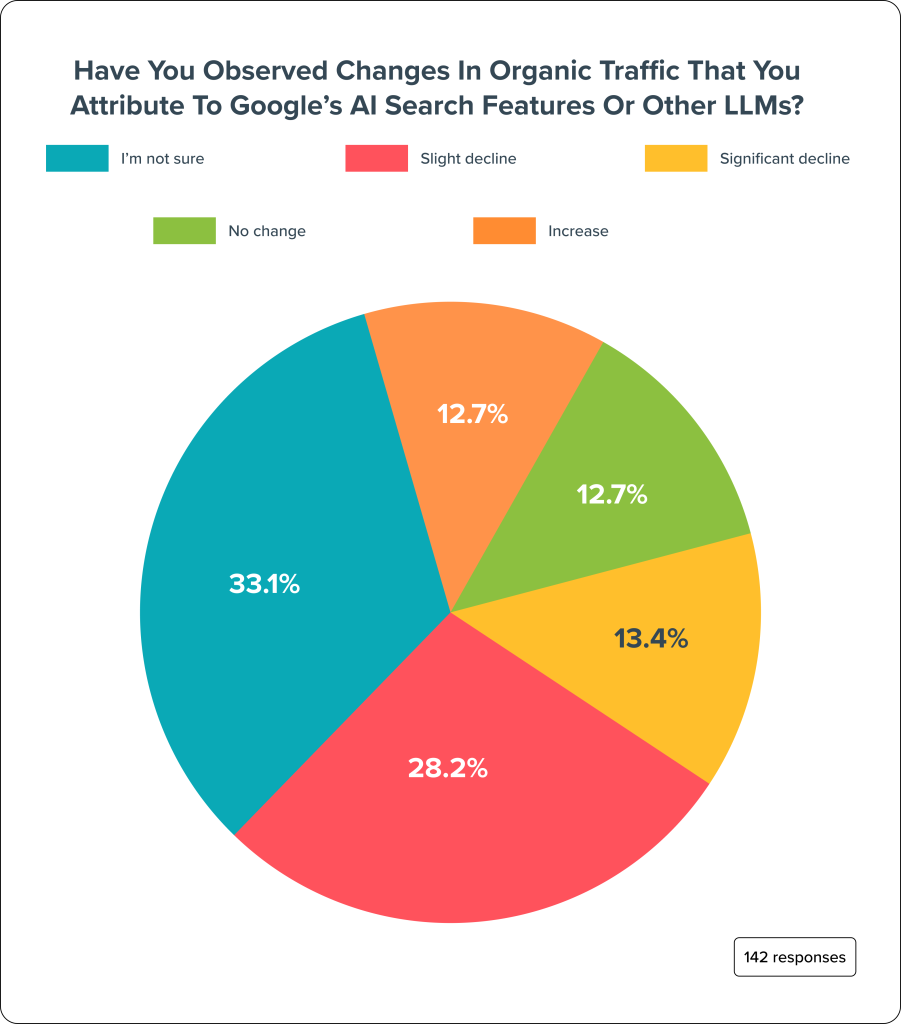
A plurality of respondents answered „I’m not sure“ when asked about AI-driven organic traffic changes. Below that group, 28.17% reported a slight decline. These were the two most popular answers by a wide margin. Rounding out the survey were “significant decline“ (13.38%) and just below them, a tie at 12.68% between “no change” and “increase.”
These answers are interesting, perhaps because they don’t tell a clear narrative. One could argue that, because approximately 42% of surveyed marketers reported seeing some decline in traffic, AI is indeed having an effect. But given that „I’m not sure“ is the single largest response category, one could also argue that the data is simply inconclusive.
Is traffic loss the real story here? Maybe. But since marketing professionals don’t yet know that to be true, perhaps it’s this uncertainty that’s the key takeaway. Evidently, there’s a blind spot preventing marketers from knowing what’s actually happening to their organic performance.
Fear of Traffic Loss vs. The Reality of Attribution
Our survey also asked open-ended questions, giving respondents more freedom to articulate their thoughts and feelings. One such question was “What is your biggest concern regarding generative search?”
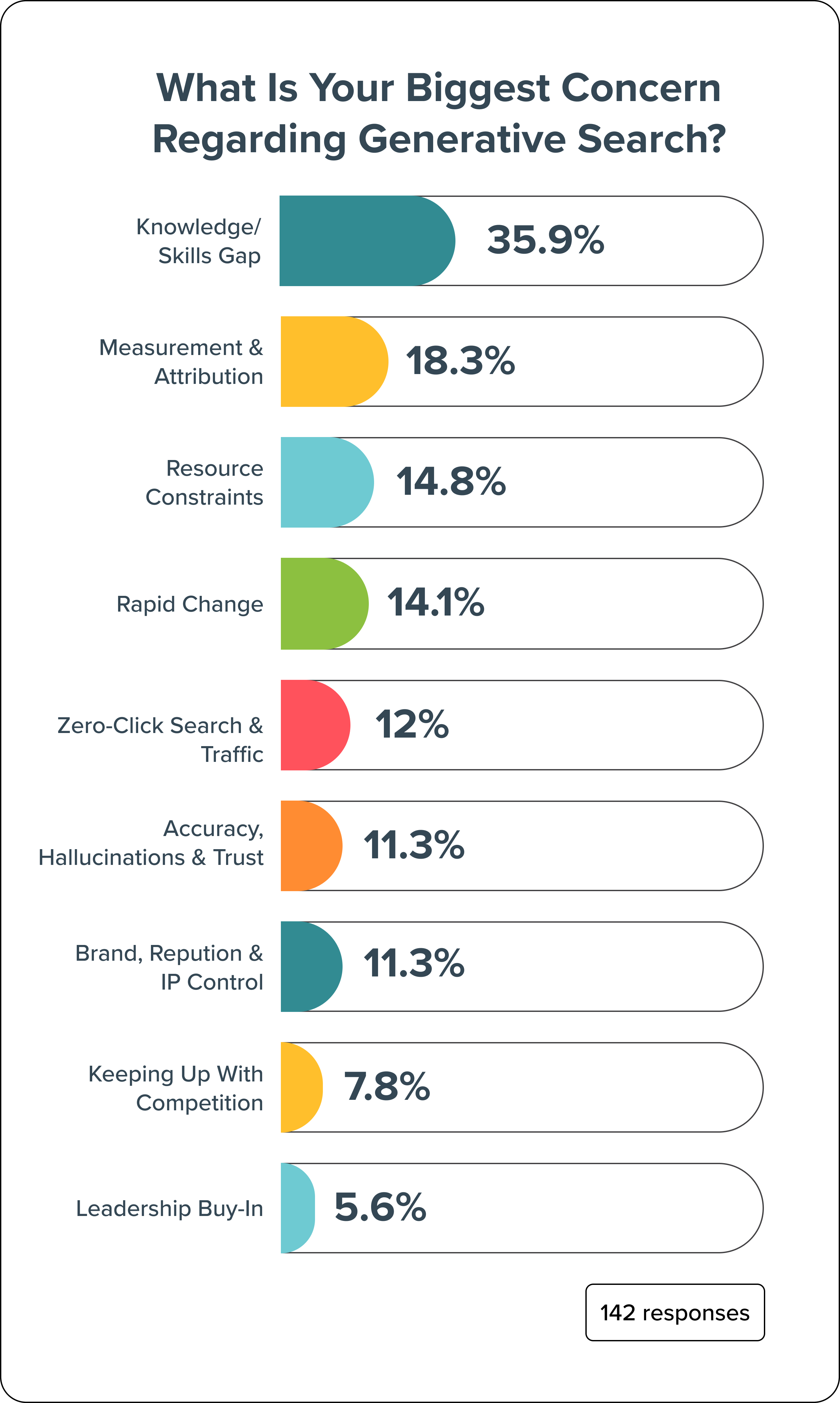
About 12% of respondents cited „Zero-Click Search & Traffic“ as their top concern. This was good enough for 5th on the list — right in the middle.
The top concerns were “Knowledge/Skills Gap” at nearly 36% and „Measurement & Attribution“ at 18.31%. Now it seems some trends are emerging. The rapid adoption of AI tools has put marketing professionals on unfamiliar terrain. Many aren’t sure what is happening. They’re worried somebody else might know more than they do. And a significant number of them don’t have the data they want and don’t know how to get it.
Zero-click search and the resulting traffic loss are prominent worries, yet an even larger group of marketers is concerned about measurement and attribution. There may be a cause-and-effect relationship here. Marketers suspect AI Overviews and LLMs are siphoning off clicks. However, because they struggle to attribute performance in generative search, they can’t confirm how much traffic they’re actually losing.
The GEO Measurement Gap
Luckily, we thought to ask our respondents about measurements.
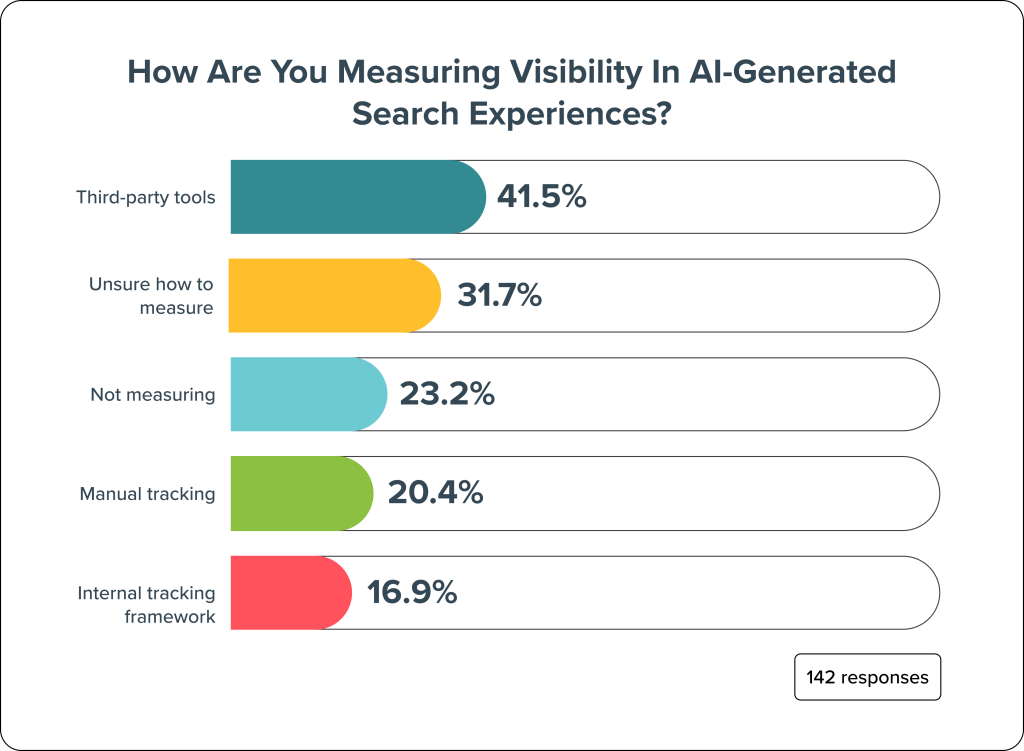
While 41.55% of respondents use third-party tools to measure AI visibility, 31.69% are unsure how to measure it, and 23.24% aren’t measuring it at all. About one-fifth rely on manual tracking, and 16.90% use an internal tracking framework.
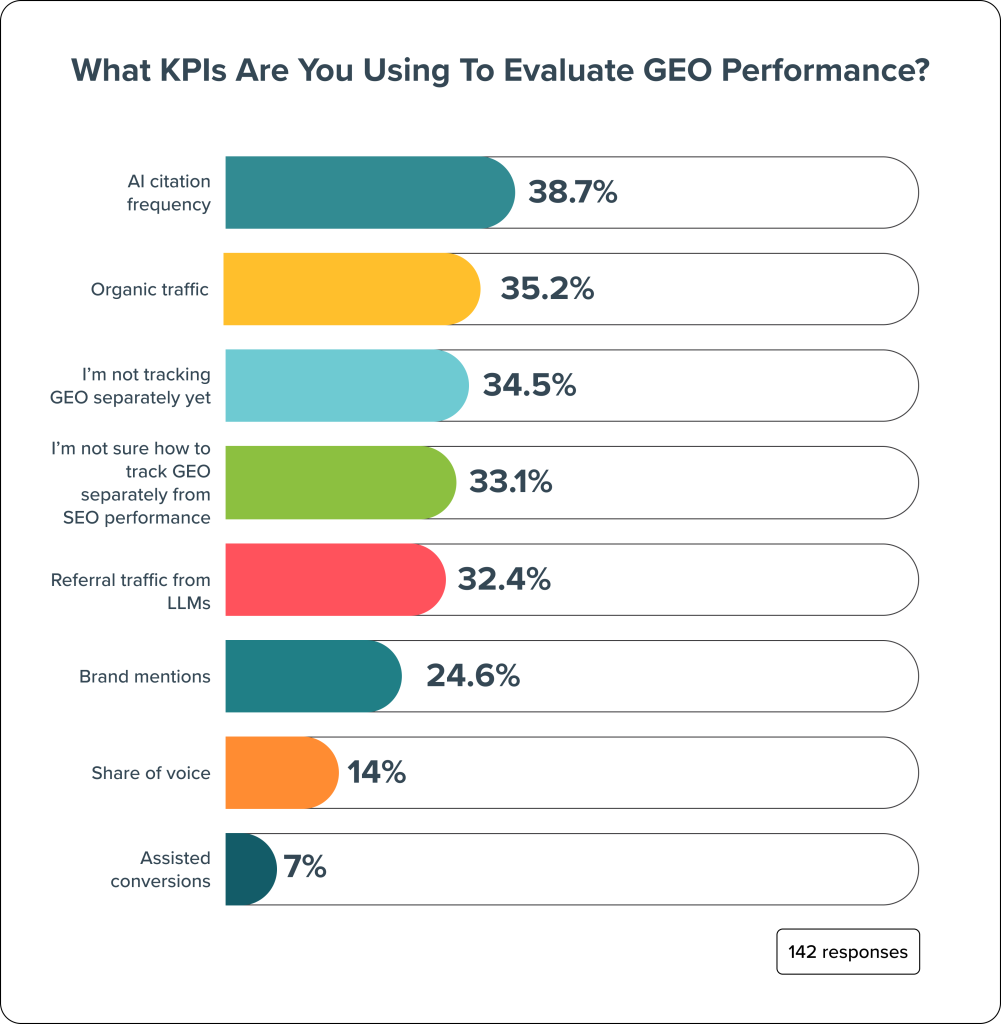
We also asked professionals what key performance indicators they use to evaluate generative engine optimization (GEO) performance. Over a third (34.51%) said they aren’t tracking GEO separately yet, and another third (33.10%) aren’t sure how to track GEO separately from traditional SEO performance.
Across our questions, we see similar-sized groups giving similar answers. There’s a significant overlap between these groups:
- The 33.10% of marketers who don’t know if AI has cost them traffic.
- The 31.69% who are uncertain how to measure AI visibility.
- And the 33.10% who aren’t yet sure how to track GEO effectively.
The upshot? If you’re feeling unsure about how AI is affecting your job, don’t worry too much. This appears to be the norm.
Uncertainty is simply an industry-wide trend at this point. Generative search metrics don’t fit neatly into traditional rank-tracking models. As a result, teams are flying (partially) blind without clear measurement workflows.
How To Get Started Measuring AI Search Effects
Surveys are great for telling you what other people are thinking, feeling and doing. They’re less useful for telling you what you should do. That’s both a broader subject and a narrower one because it depends on the specifics of your job and company.
One piece of advice that might be useful is “don’t worry too much.” There are clearly many marketing professionals who are unsure how to approach this new world of AI search and GEO. So it’s OK to not have all the answers yet.
But of course, it’s always good to be working towards answers. Thankfully, there are a few things you can do. An effective first step is to start clearing your traffic blind spots. And the good news is you don’t need an expensive, complex tech stack to do this.
Here are four accessible ways you can start measuring AI’s effects on your traffic right now:
1. Track Referral Traffic
Monitoring traffic that comes from other sites can be valuable, so knowing how much comes from LLMs is also probably useful. You can track this referral traffic in Google Analytics 4 (GA4).
You can use GA4 traffic source reports to isolate visitors clicking through from generative platforms. This can help you understand where your audience searches. It won’t tell you everything, but it provides context. If you receive hardly any traffic from LLMs, does that mean you should invest more in appearing in AI responses? Or does it mean your audience doesn’t use LLMs? You would need more evidence to say with any certainty, but surveying this traffic at least gives you some foundational data.
2. Monitor Page-Level Organic Shifts in Google Search Console
It may behoove you to pair GA4 with Google Search Console (GSC). Combining the two and using GSC’s AI Visibility features can help you spot organic traffic fluctuations across specific pages on your site.
3. Establish a Baseline for Mentions and Citations
Third-party tools, such as Ahrefs and Semrush, can help track AI citation frequency, brand mentions and share of voice. Following these metrics lets you know who — or what — is talking about your organization or products. Checking these stats regularly gives you a baseline that allows you to interrogate fluctuations.
If you put effort into creating content that appears in AI overviews, and then you see more mentions there accompanied by higher traffic, then you know your plan is working. If increased mentions don’t result in traffic rises, then this suggests it may not be a worthwhile endeavor for your company. Keep in mind, though, that these metrics are best used directionally rather than as exact bottom-line numbers.
4. Tie AI Visibility to Assisted Conversions
Don’t fall into the marketer’s trap: forgetting about conversions. The ultimate goal is always increasing revenue. Everything else, traffic included, is a means to that end. For GEO, it’s wise to track assisted conversions in your customer relationship management software to connect generative search visibility to actual revenue, as close as you can. For example, if visitors coming to your site from LLMs exhibit a higher conversion rate than average, then it’s probably worth targeting LLMs in your GEO strategy.
Tracking Your Way out of Uncertainty
You can’t optimize — or defend — organic performance if you don’t know how AI is affecting your traffic. And if you don’t know right now, remember that you’re definitely not alone. But to move out of that uncertain one-third of respondents requires setting up some tracking practices.
And remember, knowledge is power. To learn more about how GEO is affecting marketing, read our full white paper: How Are Marketers Handling GEO?