

Ask Emily Rodgers, Brafton’s Associate Director of Client Strategy and Customer Experience, what a positive customer journey comes down to. The answer sounds almost too simple: build positive, productive professional relationships.
Dig beneath the surface, and that simplicity is pulling a lot of weight. What Emily’s really describing is a mix of empathy, trust and a genuine love of the job — those are the keys to success.
The Early Days: From Selling Ad Space to Running a Publication
Emily’s career began in sales, not marketing, though her career path has inextricably linked the two. Her story began when she completed a two-year diploma in marketing management with a specialization in professional sales. Grounded with a strong academic foundation, she launched her professional path as a B2B salesperson, spanning software, financial products and even advertising space in a magazine.
Spinning off from the publication space, Emily eventually co-founded her own digital publication in a related field. Ever the strong communicator — and having been raised by a published author, excelling at English in school and studying in French immersion — writing for the publication was a natural way to overcome writer hiring challenges.
Writing then turned into yet another tool in her kit: sustainability content, then wellness-based marketing writing, a lane she stayed in for close to seven years. Along the way, she taught herself SEO from the outside in, reverse-engineering what made her own articles rank and rebuilding her process around it.
Subscribe to
The Content Marketer
Get weekly insights, advice and opinions about all things digital marketing.
Thanks for subscribing! Keep an eye out for a Welcome email from us shortly. If you don’t see it come through, check your spam folder and mark the email as „not spam.“
Why Account Management Is Farming, Not Hunting
Emily will tell you that sales has two modes: hunting (going out and winning new business) and farming (nurturing an existing account to keep it growing). Account management is the latter. It’s technically a sales role, but it doesn’t run on the instincts hunting requires.
„You don’t need to see yourself as a salesperson,“ she insists, „because you shouldn’t need to be pushing anything or hard selling anything.“ If you’re actually an expert, the recommendation comes from you as consulting rather than convincing, and the client doesn’t experience it as a sales conversation, even though, technically, it is one.
In practice, the theory holds up, provided the expertise underlying it is genuine — which is where the rest of her background and experience comes in.
5 Lessons From Emily’s Professional Toolbox
Brafton’s very own CX maven has picked up a few key skills throughout her career that directly influence her success in a strategic consulting role. For both newcomers to client strategy and those with an arsenal of experience, Emily has a few drops of wisdom:
1. Deadlines Are Not Suggestions
Success in content marketing requires a ride-or-die relationship with deadlines. “When you set a goal, it’s so important that you stick to it,” Emily advises. “Publishing workflows have an entire chain of people involved, so when you move one deadline, you risk an entire crash.”
She brought that habit directly into client strategy: Define the end goal first, then reverse-engineer the roadmap, working backward through each step required to hit it.
2. Empathy Helps You Know Your Clients and Audience
Running a publication taught Emily to keep the reader front of mind, including who they are and how they relate to your content. Interestingly, she considers that a fundamental aspect of marketing that most clients, in her experience, haven’t always practiced. She now does it on their behalf, starting with the gap between how well clients genuinely know their audience and how well they may assume they do.
3. Trust Matters More Than Being Likable
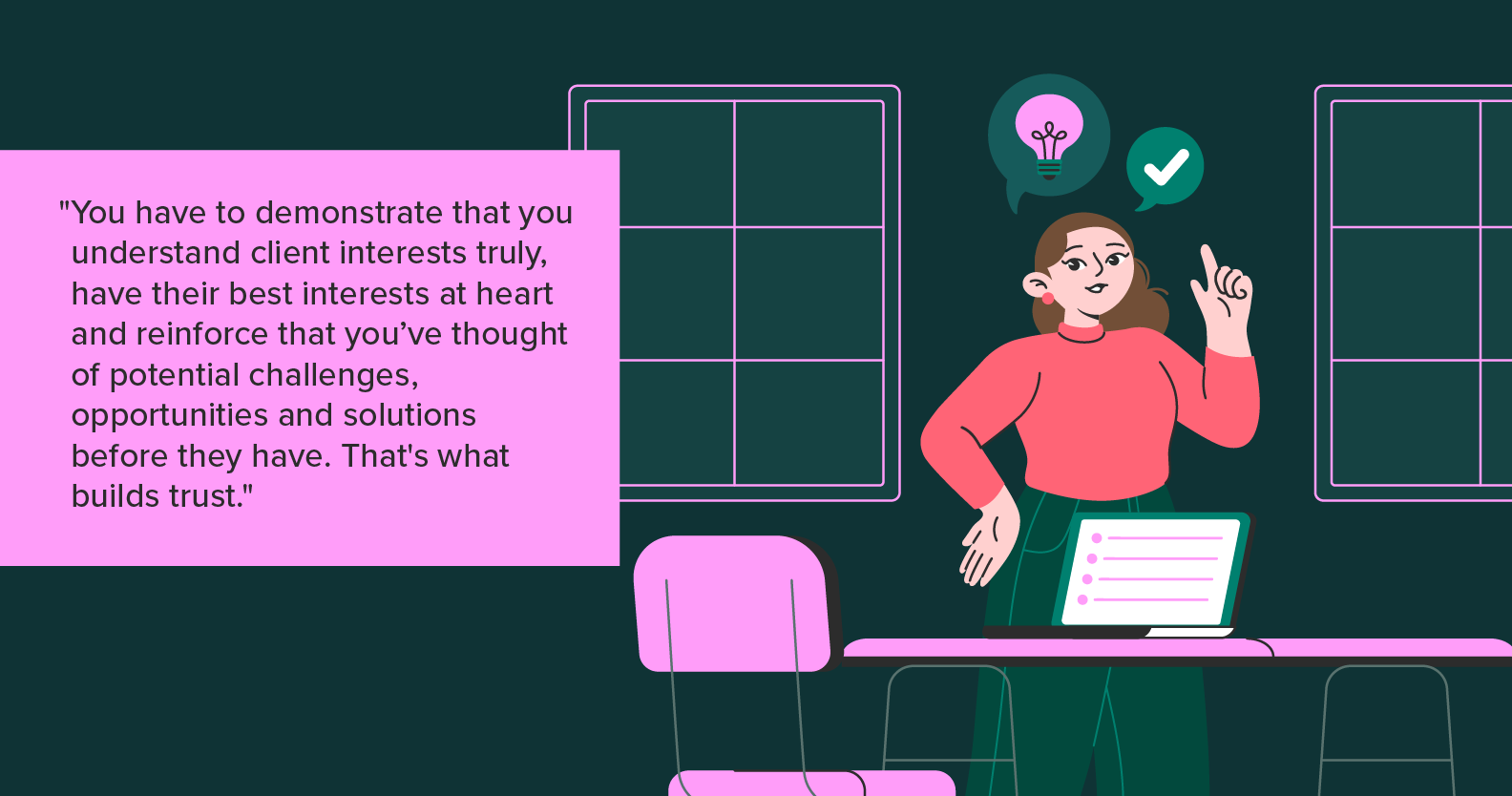
Creating success for clients comes down to establishing yourself as a trusted partner, according to Emily. “You have to demonstrate that you understand client interests truly, have their best interests at heart and reinforce that you’ve thought of potential challenges, opportunities and solutions before they have. That’s what builds trust.”
The natural byproduct is a positive customer experience. A continuous pattern of anticipation helps a client feel they’re dealing with a partner rather than a vendor. Out of that stems a long-term relationship where the client will naturally want to keep buying from you.
4. The Case for Nerding Out
In a strategic consulting role, you’ll come across clients who’ve had negative past experiences with another agency. Emily argues that the client needs to feel genuine care, not execution alone. “If you’re someone who cares so much about marketing and strategy that you can nerd out with them, that goes a very long way,” she says.
Expertise is non-negotiable, but you must meet it with enthusiasm and an authentic love of this field.
5. The Unexpected Value of Psychology and Research
An unrelated skill that helps in her job is psychology. Emily earned a degree in psychology, which she describes as a soft science but a science nonetheless: hypothesis testing, data analysis and learning to ask what a dataset can actually support.
She points out that when she first studied marketing, conventional wisdom held that marketers could never really prove ROI. When analytics tools arrived, they flipped the problem on its head. Marketers went from having virtually no data to having too much. Her training now focuses on interrogation, not collection: asking the right questions about the numbers and correcting misconceptions about which metrics actually matter and why.
Getting Lost in Translation (Intentionally)
Far removed from work-in-progress calls, Emily cultivated a crucial lesson in patience while traveling through Latin America with a limited vocabulary. Rather than being something to avoid, miscommunication was assumed from the start.
„I’ve never not gotten there with someone,“ she jokes, meaning she’s never failed to eventually reach common ground — even starting from a language gap. In that sense, misunderstanding is not a failure; it becomes round one of a longer conversation.
Travel more broadly, she observes, is one of the best tools for building rapport. Even a small shared experience, a city you’ve visited or a place a client’s friend once described, is a powerful icebreaker. As Emily knows, travel forces you out of your comfort zone often enough that meeting people, cold, gets easier the more you do it.
You Reap What You Farm
To create an exceptional customer journey, Emily will tell you that you must first really understand the customer’s goals, what they want to achieve and why. When your recommendations always map back to that conversation, the natural byproduct is that they’ll get results.
Customer experience, in other words, isn’t the end goal: It’s what happens when you approach the end goals in the right way.