

With AI becoming a pivotal resource for streamlining workflows in the modern age, digital marketers can leverage its capabilities to generate content. Getting words on paper or a device is only half the battle, though. The real challenge lies in how to put generative output to work before its final offerings reach your audience.
We surveyed 163 marketing professionals, of whom 132 use AI in their workflows. From their responses, we sought to answer the question: What separates effective AI-assisted marketing from poor-quality AI content?
In this blog, we’ll explore our key survey findings around how teams review, edit and enhance AI-generated content. We’ll also evaluate why reliance on AI output without essential human direction is a no-go and highlight practical steps digital marketers can use to produce high-quality content geared for target demographics.

What Our Survey Revealed About AI Content Review
The Most Common Ways Marketers Handle AI Output
Based on our survey results, here’s how the 132 respondents who actively use AI in their marketing efforts handle AI-generated content:
- 97 respondents fact-check and proofread all output.
- 95 respondents edit it for clarity and brand tone.
- 85 respondents utilize it as a starting point for human creatives.
- 45 respondents augment AI content with insights from subject matter experts (SMEs).
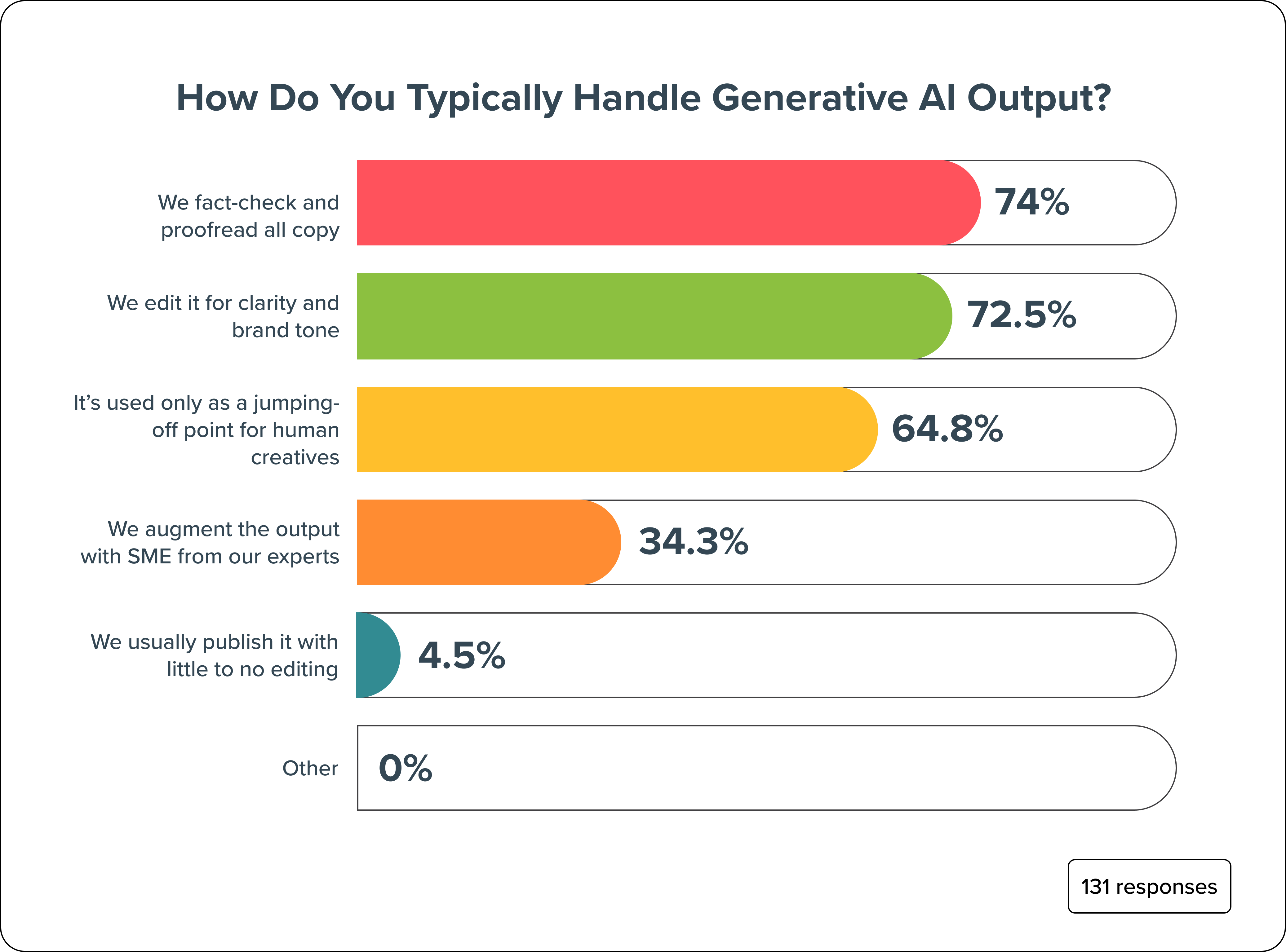
An interesting takeaway is that most marketers combine multiple review stages instead of just one to improve content quality before publication. This suggests that marketing professionals in general tend to view AI as a collaborator instead of as a replacement for human-produced content.
The Good News: Few Marketers Publish AI Content Unedited
Why is this good news for you and your brand? Only six of the 132 respondents reported publishing AI output with minimal edits and checks involved. In other words, more than 95% of marketers using AI apply at least one layer of human review before content reaches their audience.
While AI is an excellent tool for streamlining workflows, it still requires human oversight to ensure that it meets search engine optimization (SEO) best practices and user search intent. This is encouraging because the survey results suggest that concerns around quality and accuracy have actually prompted marketers to adopt disciplined workflows as AI usage gains more traction.
Subscribe to
The Content Marketer
Get weekly insights, advice and opinions about all things digital marketing.
Thanks for subscribing! Keep an eye out for a Welcome email from us shortly. If you don’t see it come through, check your spam folder and mark the email as „not spam.“
Why AI Output Should Never Be Considered Final Draft Content
There are several reasons why making AI output the be-all, end-all of your digital marketing efforts isn’t a smart move in the long run.
AI Still Struggles With Accuracy, Expertise and Originality
Our survey revealed that many respondents are concerned that relying too heavily on AI output could lead to a lack of original, accurate and authoritative digital content.
When asked about their biggest concerns regarding AI-generated content quality, 87 respondents selected „The content is thin or generic-sounding“ statement, making it the most common AI output concern by a significant margin.
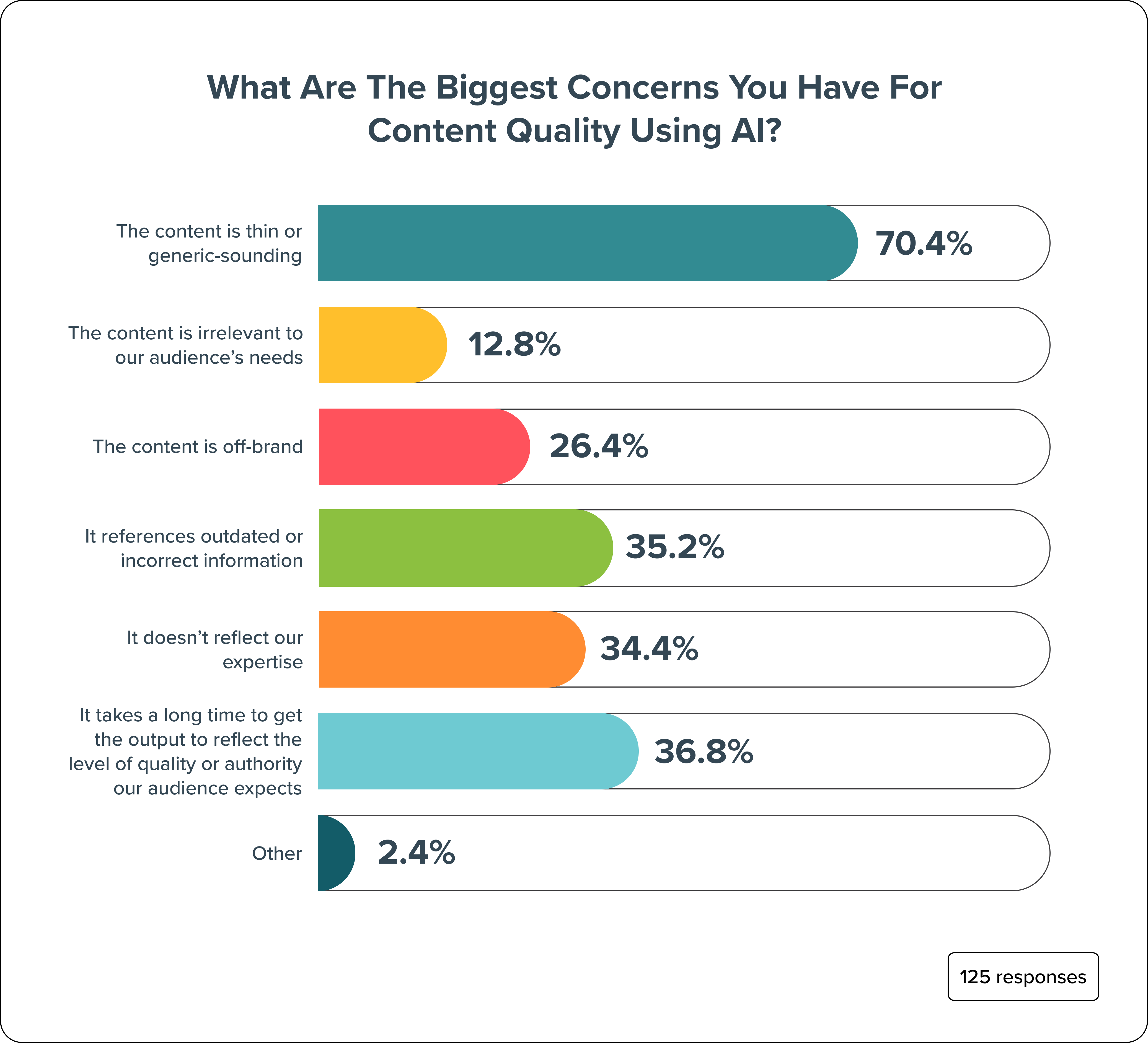
Additionally, 51 respondents worried about producing digital content with outdated or incorrect information, while 46 respondents said it takes too long to elevate AI-generated content to the level of quality and authority their audiences expect. Another 43 respondents feel that AI-generated content often fails to reflect their organization’s expertise.
What this tells us is that even as AI technology gets faster and more intuitive, marketers ultimately want to use AI as an assistant, not an author.
The Cost of Publishing AI Content Without Review
While our survey revealed that a small minority of marketers are comfortable with letting AI output take the reins in content generation, there are several risks involved with publishing AI-generated content without careful review:
- Compromising brand reputation.
- Customers losing trust in the content’s factual accuracy.
- Scaling content ahead of maintaining SEO quality.
Imagine that you’re a marketer who works for a B2B software company using AI to write a blog. The AI cites cybersecurity regulations, but its sources are outdated. After publication, prospects and your in-house SME notice these inaccuracies and question your company’s expertise.
Even a few factual errors can damage credibility, reduce trust in future content and make potential customers less likely to view your brand as an authoritative source.
5 Best Practices for Managing AI Output
From stronger prompt engineering and fact-checking to brand refinement and SME input, these five best practices can help transform AI-generated first drafts into final pieces containing accurate, authoritative and audience-focused content:
1. Use AI as a Starting Point, Not the Final Product
One of the strongest themes in our survey was that most marketers view AI as a jumping-off point rather than a final destination.
For example, these respondents might argue that an AI-generated blog that is edited or updated by a human can effectively narrow the focus and overcome writer’s block. The strongest content still comes from human marketers who build upon AI-generated foundations with strategic thinking, creativity and expertise.
2. Improve the Input Before Improving the Output
Creating better prompts with specific context and constraints equals better content generation — and reduced editing time in the long run.
When using AI tools, consider including the following information in your prompts:
- Audience information.
- Brand voice guidelines.
- Desired format and structure.
- Relevant background context.
- Specific objectives for the content.
This approach seems to work well for one survey respondent, who said, “Custom GPTs trained on style and tone eliminate massive editing after [the content] has been created.”
As it happens, we’ve noticed this at Brafton, too; that’s partly what led us to create contentmarketing.ai, an AI platform designed to create content stringently based on brand guidelines.
3. Fact-Check Everything Before Publishing
Fifty-one survey respondents specifically identified hallucination tendencies and outdated or incorrect information as one of their biggest AI content concerns. For organizations operating in finance, health care, education or professional services, a single factual error can damage trust and undermine brand authority.
By implementing practical verification workflows, you can enhance the factual accuracy of your digital content exponentially.
4. Edit for Brand Voice, Clarity and Audience Relevance
AI has taken tremendous strides in emulating the human voice. However, one of the most common criticisms thrown at AI-generated content is that it sounds generic, failing to effectively capture the nuances of human storytelling and judgment.
With that said, concerns about off-brand messaging ranked much lower this time around than in our previous survey. This may indicate that marketers are becoming more effective at prompting AI systems and integrating brand guidelines into their workflows to improve readability and increase user engagement.
5. Add Subject Matter Expertise Wherever Possible
Our survey findings suggest that marketers are increasingly turning to SME collaboration for interviews, surveys, internal reviews, proprietary insights and original research to create content that AI alone cannot replicate.
For instance, 43 respondents said AI-generated content fails to reflect their expertise. As such, 45% of respondents now augment AI output with human oversight by using SMEs to produce digital content that creates authority for their brands and differentiation from competitors. These outcomes align with a similar study done by the Anthropic Economic Index, which asserts that 57% of economic professionals use AI tools for augmentation, whereas 43% utilize AI capabilities purely for automation purposes in comparison.
Our survey outcomes suggest that you can improve AI output for content creation with a logical process involving:
- Prompting.
- Generating.
- Verifying.
- Refining.
- Enhancing.
4 Questions Every Marketer Should Ask Before Publishing AI Content
Before publishing AI-assisted content, marketers should follow a consistent review process by asking the right questions about accuracy, brand alignment, expertise and originality.
1. Is This Accurate and Up To Date?
While a helpful content production tool, AI is far from perfect. Human fact-checking is essential for checking AI-generated content, which often contains incorrect or outdated information at the best of times.
So, before you head straight to the proverbial presses and tell users to “Read all about it!”, you first need to verify every statistic, claim, quote or factual statement made in your content against reputable sources.
Keep in mind that many AI tools don’t always have the latest information at their disposal. For instance, GPT 5-5, the latest version of ChatGPT, was released in April 2026 and has a knowledge base with information that’s as recent as December 2025. That’s why marketers must ensure that examples, regulations, industry trends and product information they include in their digital content are current and haven’t changed since the AI model they’re using was trained.
2. Does This Reflect Our Brand Voice?
AI tools tend to create content with generic phrasing, so always review your prompts for tone, style and messaging consistency.
By feeding AI tools with language examples and perspectives from your brand’s sources, you can help generate content that sounds uniquely like your organization and appeals to your audience in ways that best align with their expectations and pain points. Running the draft through an AI detector can also help flag phrasing that still needs more brand voice.
3. Would An Industry Expert Approve This Content?
The question you need to ask yourself is whether the AI-generated content you’ve prompted demonstrates genuine expertise or merely repeats widely available information that anyone could produce.
Look for opportunities to incorporate expert insights, examples or commentary that strengthen your content’s authority and reliability. By getting SMEs to assist, you can review key sections more thoroughly for accuracy, nuance and credibility.
4. Does This Provide Original Value For The Audience?
Another question you should be asking is whether the content offers unique insights, practical advice or perspectives beyond what AI could generate on its own.
More importantly, does the piece you’ve created using AI answer audience questions more effectively than competing content?
It’s possible to achieve true differentiation by creating helpful content that offers authentic, first-hand experience, customer insights or proprietary data that can’t be found anywhere else.
The Gold Standard for AI-Assisted Marketing Content
The survey findings point toward a consistent pattern among high-performing teams. Rather than relying on AI to replace human expertise, marketers are layering AI-generated content with multiple forms of oversight and insight.
Based on the survey’s results, combining AI efficiency with human judgment can help marketers achieve a more sustainable, long-term content strategy that relies on:
- AI for ideation and drafting.
- Human editing and fact-checking.
- SME augmentation.
Final Thoughts
It’s true: AI has accelerated marketing workflows in recent years, but effective output quality still needs that innate human touch. This is supported overwhelmingly by the survey respondents who favor review, editing and verification over blind AI automation and generation.
Instead of viewing it as a replacement for human direction, the most effective marketers treat AI as an ally in the battle for generating high-quality, authoritative content that answers users’ search intent and speaks to their various pain points.
The time is ripe for using AI capabilities effectively and responsibly through repeatable review processes that blend creativity, accuracy, brand alignment and expertise.