

Everyone’s talking about generative engine optimization (GEO), but how many businesses are actually putting money behind it? As AI-generated search experiences change how people discover brands, marketers are figuring out what GEO means for their content strategies, measurement practices and budgets.
Some businesses are investing in dedicated tools and resources. Others are still trying to convince leadership that GEO deserves its own line item. Then, there are those experimenting with whatever resources they already have.
So, does having a dedicated GEO budget make a difference?
We examined responses from 142 participants in Brafton’s GEO research to understand who’s investing, what funded teams are doing differently and how marketers can make progress without dedicated funding.
Here’s what we found.
Subscribe to
The Content Marketer
Get weekly insights, advice and opinions about all things digital marketing.
Thanks for subscribing! Keep an eye out for a Welcome email from us shortly. If you don’t see it come through, check your spam folder and mark the email as „not spam.“
Who Actually Has a Dedicated GEO Budget?
When we asked whether companies had allocated a specific budget toward GEO efforts, the majority said no.
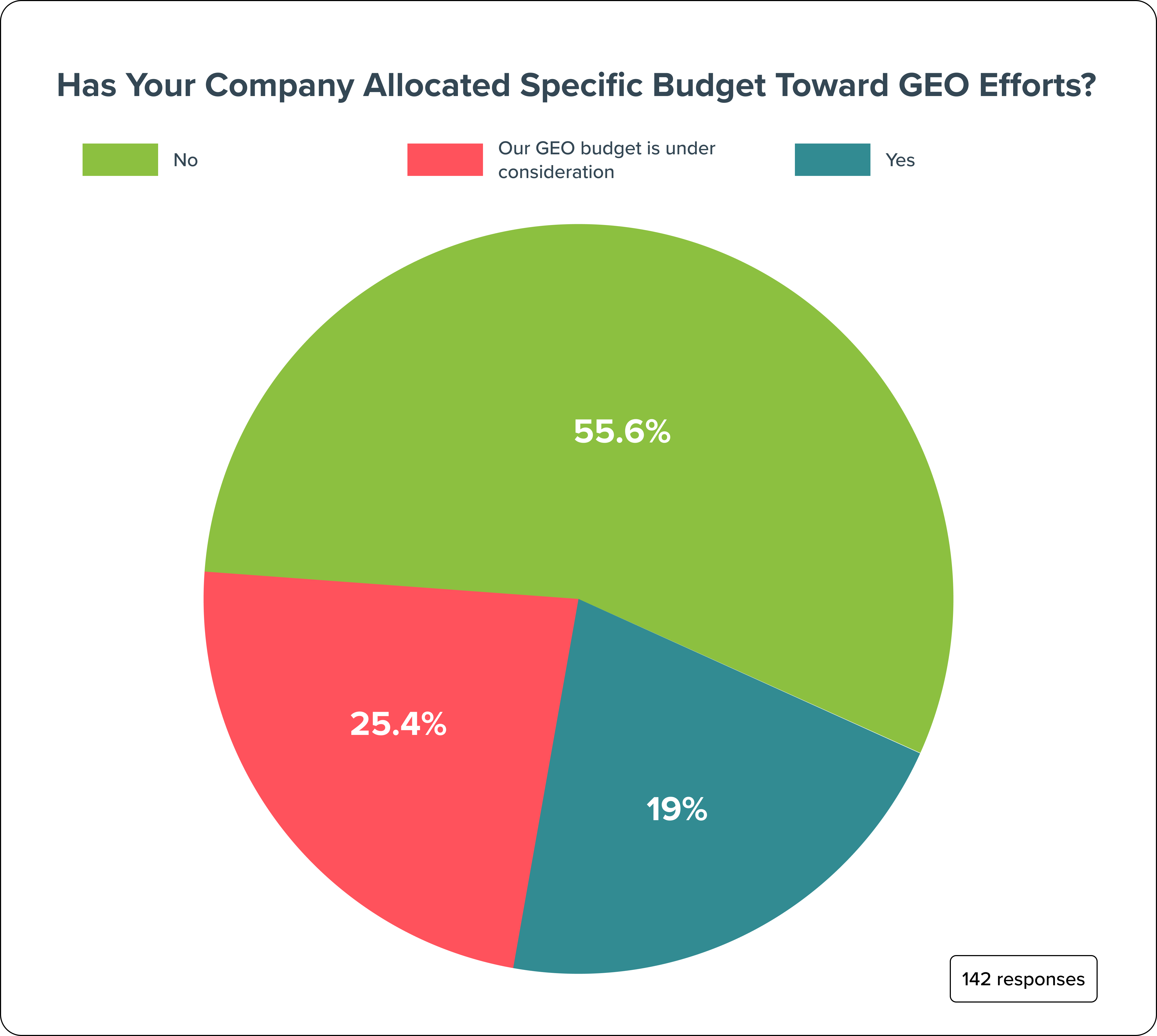
Fewer than 1 in 5 respondents had a dedicated GEO budget, but with roughly a quarter considering an investment, many businesses appear to be evaluating where GEO fits into their marketing priorities.
And the breakdown gets more interesting when we look at company size.
Does Company Size Make a Difference?
Among small businesses, 71.05% reported having no dedicated GEO budget, the highest proportion of any company-size group surveyed.
For medium and large businesses, the numbers were more evenly distributed:
- Medium: 46.43% had no budget, while 25% had allocated funding.
- Large: 45.45% had no budget, while 22.73% had allocated funding.
- Enterprise: 59.38% had no budget, while 18.75% had allocated funding.
Here’s an interesting twist: Enterprise businesses weren’t leading the way. In fact, enterprise respondents were more likely to report having no dedicated GEO budget than their medium and large counterparts.
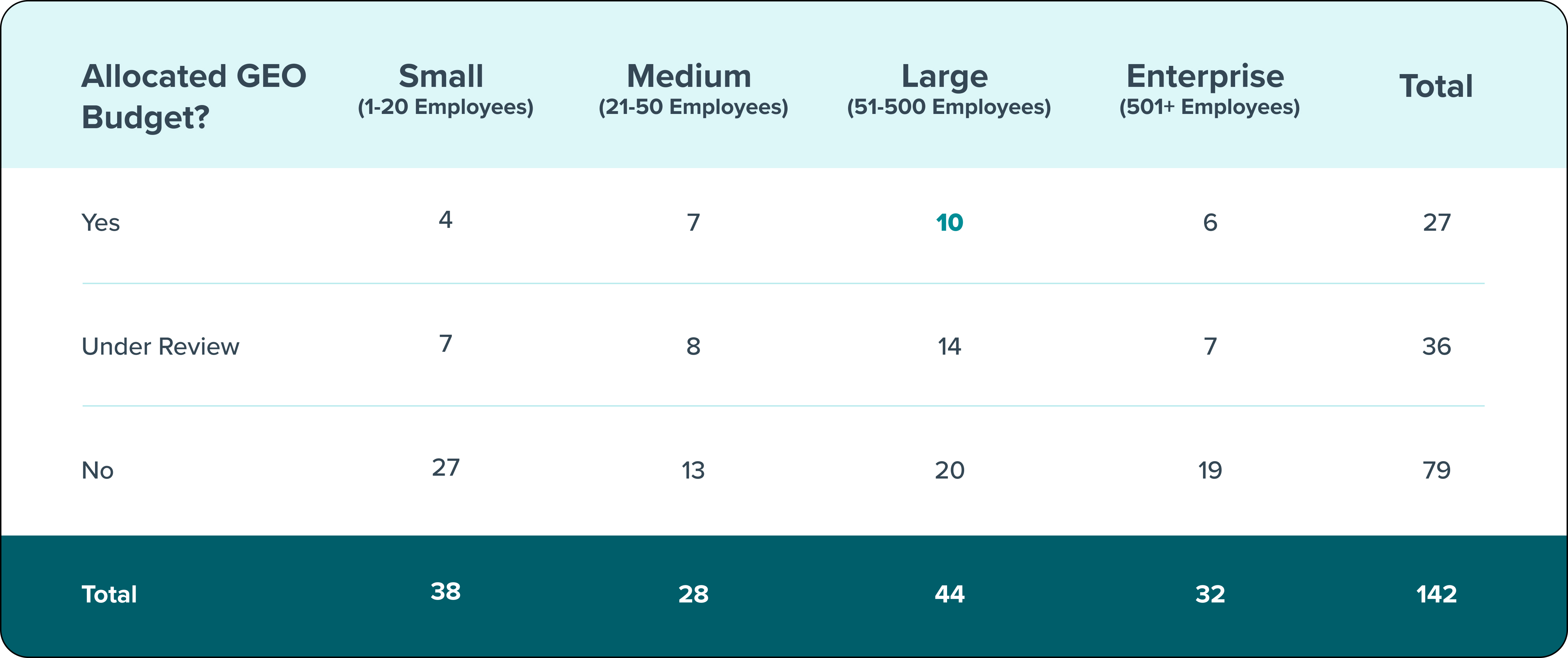
Our survey doesn’t establish why. However, it does suggest that company size alone doesn’t determine whether GEO receives dedicated funding.
Which Industries Are Investing?
Technology and software businesses had the highest number of respondents with confirmed GEO budgets (7 of 24), followed by marketing, advertising and SEO/GEO businesses (6 of 15).
Financial services, insurance and FinTech stood out for another reason: Seven of 11 respondents said their GEO budget was under consideration. Meanwhile, respondents in education and EdTech (11 of 18) and health care and life sciences (10 of 14) frequently reported having no dedicated funding.
These industry samples are relatively small, but they illustrate how differently organizations are approaching GEO investment.
What Are Marketers With GEO Budgets Doing Differently?
Having a budget is one thing. What businesses actually do with it is another. We compared respondents‘ budget status with changes to their content strategies and how they measure AI search visibility.
The differences were noticeable.
Funded Teams Are Making More Content and Technical Changes
Among respondents with dedicated GEO budgets, 77.78% reported making intentional structured data or schema updates, compared with 34.18% without dedicated budgets.
We also found that:
- 62.96% of funded respondents were optimizing for conversational queries, compared with 35.44% without budgets.
- 62.96% were building brand authority signals, compared with 29.11% without budgets.
- 59.26% were creating more authoritative long-form content, compared with 36.71% without budgets.
- 44.44% were incorporating more subject matter expert (SME) contributions, compared with 29.11% without budgets.
Across these activities, respondents with dedicated funding were generally more likely to report making changes.
That doesn’t mean the budget caused those changes or that the activities improved AI search performance. But it does suggest a relationship between dedicated resources and more active GEO strategies.
Measurement Is Another Major Difference
The contrast becomes even clearer when we look at measurement. Among respondents with GEO budgets, 70.37% reported using third-party tools to measure AI search visibility. Among those without budgets, that figure dropped to 31.65%.
Funded respondents were also more likely to use manual tracking (33.33% versus 15.19%) and internal tracking frameworks (33.33% versus 10.13%). Meanwhile, 34.18% of respondents without dedicated budgets weren’t measuring AI search visibility at all. None of the funded respondents selected that answer.
Of course, measurement isn’t straightforward. AI-generated responses can vary between platforms, prompts and individual searches. Even specialized tools provide only a particular view of visibility. The takeaway isn’t that every business needs an expensive tracking platform. It’s that funded businesses appear more likely to be actively monitoring their GEO efforts.
What About Businesses Still Waiting for a GEO Budget?
Here’s where the research gets particularly interesting. Businesses whose GEO budgets were still under consideration weren’t necessarily waiting around for approval.
Among these respondents:
- 58.33% were creating more authoritative long-form content.
- 52.78% were making structured data or schema updates.
- 50% were optimizing for conversational queries.
- 50% were incorporating more SME contributions.
That’s a considerable amount of activity for businesses without approved dedicated funding. It suggests that GEO is already becoming part of existing content and SEO workflows, even before organizations formally allocate resources.
And that’s an encouraging starting point for marketers who aren’t expecting a new budget anytime soon.
How To Approach GEO Without a Dedicated Budget
No GEO budget? You’re certainly not alone. You don’t necessarily need new software or an entirely separate content program to start exploring generative search optimization. Many GEO activities overlap with established SEO and content marketing practices.
Start With What You Already Have
Before commissioning 20 new articles about AI search, take a look at what’s already on your website. Identify important pages that could benefit from clearer explanations, updated information or better organization. Look for opportunities to answer customer questions directly and make existing resources more useful.
The objective isn’t to rewrite everything for an AI audience. It’s to create genuinely helpful content for the people searching for it.
Put Your Internal Expertise To Work
One practical way to strengthen content is to involve the people who know your products, services and customers best. Interview a product specialist, ask your sales team about recurring questions or incorporate insights from someone working directly in your industry.
Original perspectives and firsthand expertise can make content more valuable without requiring an entirely new marketing budget. Unlike another generic article covering the same talking points as everyone else, those insights give your brand something distinctive to contribute.
Strengthen Your SEO Foundations
GEO shouldn’t mean abandoning the technical fundamentals that help search engines discover and understand your website. Review important pages for crawlability, clear headings, descriptive metadata and appropriate structured data.
Schema markup can help search engines interpret certain information, although adding it doesn’t guarantee inclusion in AI-generated responses.
Start Tracking What You Can
You don’t need an elaborate dashboard to begin learning how your brand appears in AI search. Create a consistent list of relevant prompts and periodically examine how your brand and competitors appear across selected AI search experiences. Record observable mentions, citations and changes over time.
Manual results can vary and shouldn’t be treated as comprehensive visibility measurements. Still, a simple tracking process can help identify opportunities and build a stronger case for future investment.
Where Should You Invest if You Have a GEO Budget?
Having dedicated funding creates more options. But where should the money go?
Our research shows funded businesses are more likely to report structured data updates, brand authority initiatives and AI visibility measurement. Those findings offer useful starting points, although priorities should reflect your existing capabilities and goals.
Invest in Better Measurement
If manual tracking is becoming difficult to manage, specialized AI visibility tools may help you monitor more prompts, platforms and competitors. Look for transparent methodologies and actionable information rather than relying on a single visibility score.
Expand Expert-Led Content
Dedicated funding can support SME interviews, original research, detailed resources and content updates requiring specialist input. These investments can strengthen your broader content strategy, regardless of how AI search evolves.
Address Technical and Content Gaps
Use your budget to resolve issues identified through SEO audits, improve important pages and make technical enhancements where appropriate. Prioritize actual website needs rather than assuming every emerging GEO tactic deserves investment.
Build a Testing and Reporting Process
Set clear objectives, establish baseline measurements and document the changes you’re making. Where possible, evaluate GEO initiatives alongside organic search performance, referral traffic, engagement and conversions.
This makes it easier to understand what your investment is accomplishing and where adjustments may be needed.
GEO Success Isn’t Just About the Budget
Our research reveals a clear relationship between dedicated GEO funding and reported marketing activity. Businesses with budgets are more likely to be making content and technical changes, investing in brand authority and measuring AI search visibility.
But many businesses without approved budgets are already adapting. They’re improving content, incorporating expert perspectives and experimenting with the resources they have. A dedicated budget can help expand those efforts, but it doesn’t automatically make a GEO strategy effective.
For marketers still waiting on funding, the next step may be identifying what can be improved within existing SEO and content workflows. For those with budgets, the challenge is making sure that investment supports meaningful objectives rather than simply adding another set of tools.
Either way, the goal is to understand how generative search is changing brand discovery, make informed improvements and measure what you can.
The budget conversation matters, but what you do with the resources available matters just as much.